+1 (561) 295-3504


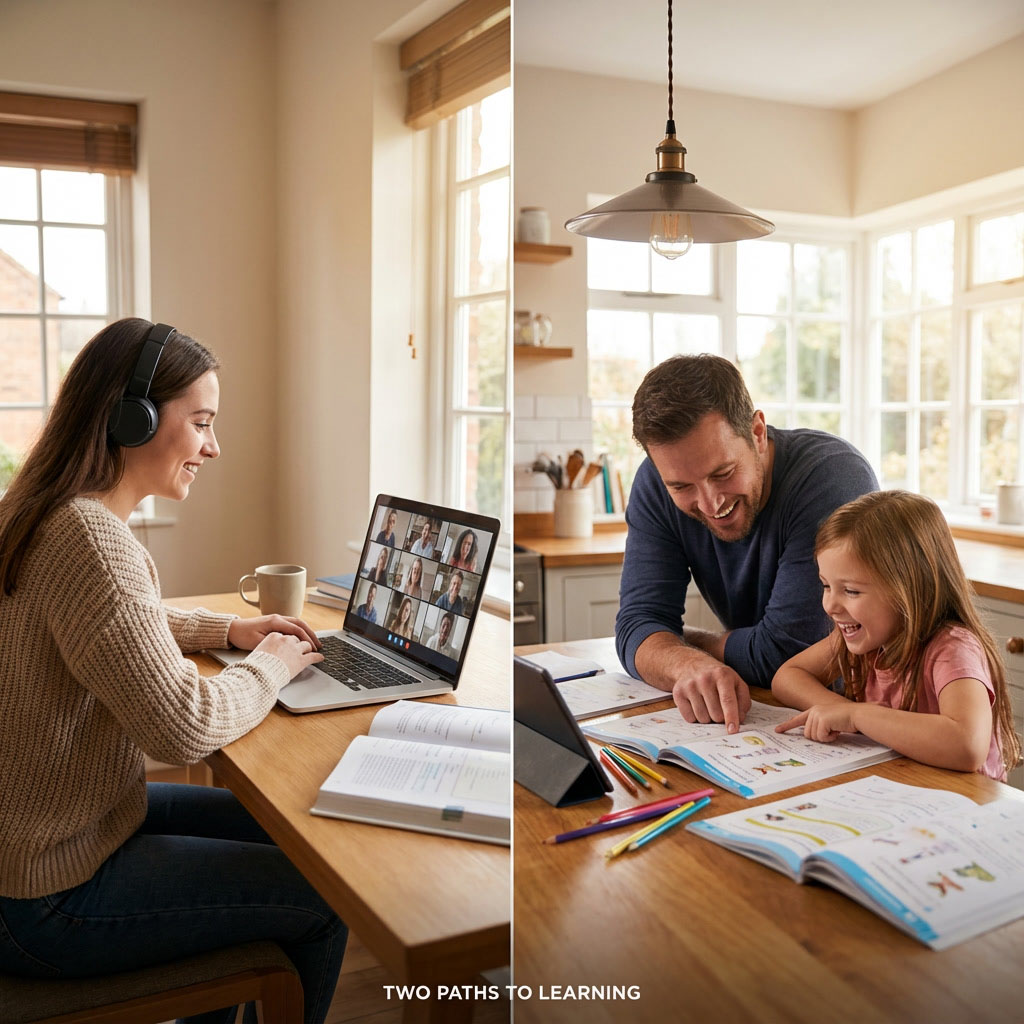
Online school and homeschool are not the same thing, even though people use the terms interchangeably all the time. The core difference comes down to who's responsible for the education.
In online school, an accredited institution provides the curriculum, instruction, and assessment through certified teachers. In homeschool, parents take on that responsibility themselves, selecting curriculum and directing their child's education.
Both happen at home, which is where the confusion starts, but the day-to-day experience and the paperwork involved look completely different.
If you're trying to decide between these two options, understanding what each actually requires will save you from choosing something that doesn't fit your family. Let's break down how they differ and what that means practically.
It makes sense that these get mixed up. In both cases, a kid is learning at home instead of going to a physical school building. From the outside, it can look identical. Your neighbor sees your child home during school hours and assumes you're homeschooling, regardless of whether your kid is logged into live classes with a teacher or working through a parent-selected curriculum at the kitchen table.
But the similarities mostly end at location. The structure, responsibilities, credentials, and legal requirements differ significantly. Choosing the wrong one because you didn't understand the distinction can create real problems, from overwhelmed parents who didn't realize what homeschooling required to families stuck in rigid online programs when they wanted more flexibility.
Online school operates like a traditional school, just delivered virtually. An accredited institution employs certified teachers who provide instruction, assign coursework, grade assignments, and issue report cards. Students follow a set curriculum, meet deadlines, and receive a diploma from the school upon completion.
The parent's role in online school is supportive rather than instructional. You're making sure your child logs in, has a quiet place to work, and stays on track with assignments. But you're not teaching algebra or grading essays. Teachers handle that.
Most online schools follow an academic calendar similar to traditional schools, though some offer more flexibility in pacing. Students interact with teachers through live video classes, discussion boards, email, and sometimes phone calls. They're part of a school community, even if that community exists virtually.
When your child completes online school, they receive a transcript and diploma from that institution. Colleges evaluate these credentials the same way they evaluate transcripts from brick-and-mortar schools, assuming the online school holds proper accreditation.
Homeschooling puts parents in the driver's seat. You select the curriculum, deliver instruction, assess progress, and document everything according to your state's requirements. Some parents follow structured curricula purchased from educational publishers. Others take an unschooling approach with student-led learning. Most fall somewhere in between.
The flexibility is enormous. Homeschooling families can study ancient Rome for a month if that's what captures their child's interest, then speed through a math unit that clicks quickly. There's no external schedule to follow, no teacher waiting for assignments, no rigid pacing guide.
That flexibility comes with responsibility. According to the Coalition for Responsible Home Education, homeschool regulations vary dramatically by state. Some states require virtually nothing. Others mandate curriculum approval, standardized testing, or portfolio reviews. Parents need to understand and comply with their state's specific requirements.
When a homeschooled student finishes high school, they typically don't receive a diploma from an accredited institution. Parents issue the diploma themselves, or students pursue a GED. College applications require additional documentation to demonstrate academic preparation, and the process can be more complicated than applying with a traditional transcript.
One of the biggest practical differences involves curriculum.
In online school, the curriculum is determined by the institution. Students take required courses in English, math, science, and social studies, plus electives from whatever the school offers. Parents don't choose the textbooks or design the lesson plans. They might have some input on elective selection or course levels, but the overall academic program is set by the school.
In homeschool, parents choose everything. You might purchase a complete curriculum package from a publisher, cobble together resources from multiple sources, or create your own materials entirely. This allows for tremendous customization but requires significant research and planning. A parent homeschooling a high schooler needs to ensure they're covering material that prepares their child for college or career, and that's a real responsibility.
Some families land in the middle by using online curriculum providers that aren't full schools. These services provide structured lessons and sometimes grading, but the parent remains the official educator and the student isn't enrolled in an accredited institution. This can offer some of online school's structure with more of homeschool's flexibility, though it doesn't come with an accredited diploma.
Let's be honest about what each option requires from parents.
Online school requires parental support but not instruction. You need to ensure your child has the technology and environment to succeed. Younger students, particularly in middle school grades, may need help staying organized and meeting deadlines. But you're not responsible for teaching the content. If your child struggles with chemistry, the teacher handles that.
Homeschooling requires much more direct involvement. Even if you use a packaged curriculum, you're the one explaining concepts, answering questions, and determining whether your child has mastered the material. Some parents love this deep involvement in their child's education. Others find it overwhelming, especially if they're also working or managing multiple children at different grade levels.
Think carefully about your own capacity. Homeschooling a high schooler through calculus and AP English requires either subject matter expertise or the ability to find and coordinate outside resources. It's absolutely doable, but it's not a minor commitment.
This is where the rubber meets the road for many families, especially those thinking about college.
Accredited online schools issue transcripts that colleges recognize and accept. Credits transfer if a student changes schools. The diploma carries institutional weight. For families who want a straightforward path to college admission, this simplicity has real value.
Homeschool transcripts are parent-created documents. They can absolutely support successful college applications, and many homeschooled students attend excellent universities. But the process requires more work. Parents need to document coursework thoroughly, often provide additional context about curriculum and grading standards, and sometimes supplement with standardized test scores or outside evaluations.
Neither path is inherently better for college admission. But they require different approaches to documentation and potentially different timelines for application preparation.
Both online school and homeschool face questions about socialization, but the specifics differ.
Online school typically includes some built-in social interaction. Students participate in live classes with peers, work on group projects, and may have access to virtual clubs or activities. The social component isn't as immersive as a physical school, but it exists as part of the program.
Homeschool socialization is entirely parent-driven. You need to seek out co-ops, sports leagues, community groups, or other opportunities for your child to interact with peers. Many homeschool communities have robust social networks, but accessing them requires effort and initiative.
For families where the social aspect of traditional school was a problem, whether due to bullying, social anxiety, or other issues, both options provide relief. The difference is whether you want some social structure built into the educational program or prefer to arrange it entirely on your own terms.
Online school handles most legal requirements for you. The school maintains enrollment records, reports attendance, and issues transcripts. You're a parent of a student enrolled in a school.
Homeschooling means navigating your state's home education laws yourself. Depending on where you live, this might mean filing a notice of intent, maintaining attendance records, administering standardized tests, or submitting to portfolio reviews. The requirements vary enormously by state, and compliance is the parent's responsibility.
Before deciding to homeschool, research your state's specific requirements. What sounds like freedom can come with more bureaucratic overhead than expected in some states, while other states truly do allow families to operate with minimal oversight.
The right choice depends on what you're looking for and what you're able to provide.
Consider online school if you want:
Consider homeschool if you want:
Some families start with one and switch to the other as circumstances change. A parent who homeschooled through elementary school might transition to an accredited online high school to ensure a smoother college application process. A family that tried online school but found it too rigid might move to homeschooling for more flexibility. Neither choice has to be permanent.
Is online school considered homeschool?
No. Online school and homeschool are legally and practically different. In online school, students are enrolled in an accredited institution with certified teachers providing instruction. In homeschool, parents are responsible for directing the education and selecting curriculum. Both happen at home, but the structure and responsibilities differ significantly.
What's the main difference between online school and homeschool?
The main difference is who provides the education. Online school delivers instruction through an accredited institution with certified teachers. Homeschool places that responsibility on parents, who select curriculum and direct learning themselves.
Do colleges accept homeschool students?
Yes. Many colleges actively recruit homeschool students, and homeschoolers attend universities across the country. However, the application process may require additional documentation compared to students from accredited schools, including detailed descriptions of coursework and sometimes additional standardized testing.
Which is easier for parents, online school or homeschool?
Online school typically requires less direct involvement since teachers handle instruction and assessment. Parents support the student but don't need to teach content. Homeschooling requires more active participation in curriculum selection, instruction, and evaluation. The right choice depends on how much involvement you want and can realistically manage.
Can you switch between online school and homeschool?
Yes. Families can transition between options as needs change. A student might homeschool for elementary years and switch to online school for high school, or vice versa. Consider factors like accreditation, credit transfer, and documentation when making transitions.
Is online school more structured than homeschool?
Generally, yes. Online schools follow set curricula with deadlines, grading periods, and academic calendars. Homeschool allows families to set their own pace and structure. Some families prefer online school's built-in accountability, while others value homeschool's flexibility.
Learn what live online classes look like for K-12 students, how formats compare, why class size matters, and where to find a truly personalized option. Explore now.

Learn how self-paced online school works, who it fits best, and what accreditation and teacher involvement really mean before you choose a program.

Self-paced or live online school? This guide breaks down real differences, learning profiles, and how to find the right fit for your child. Start comparing now.