+1 (561) 295-3504


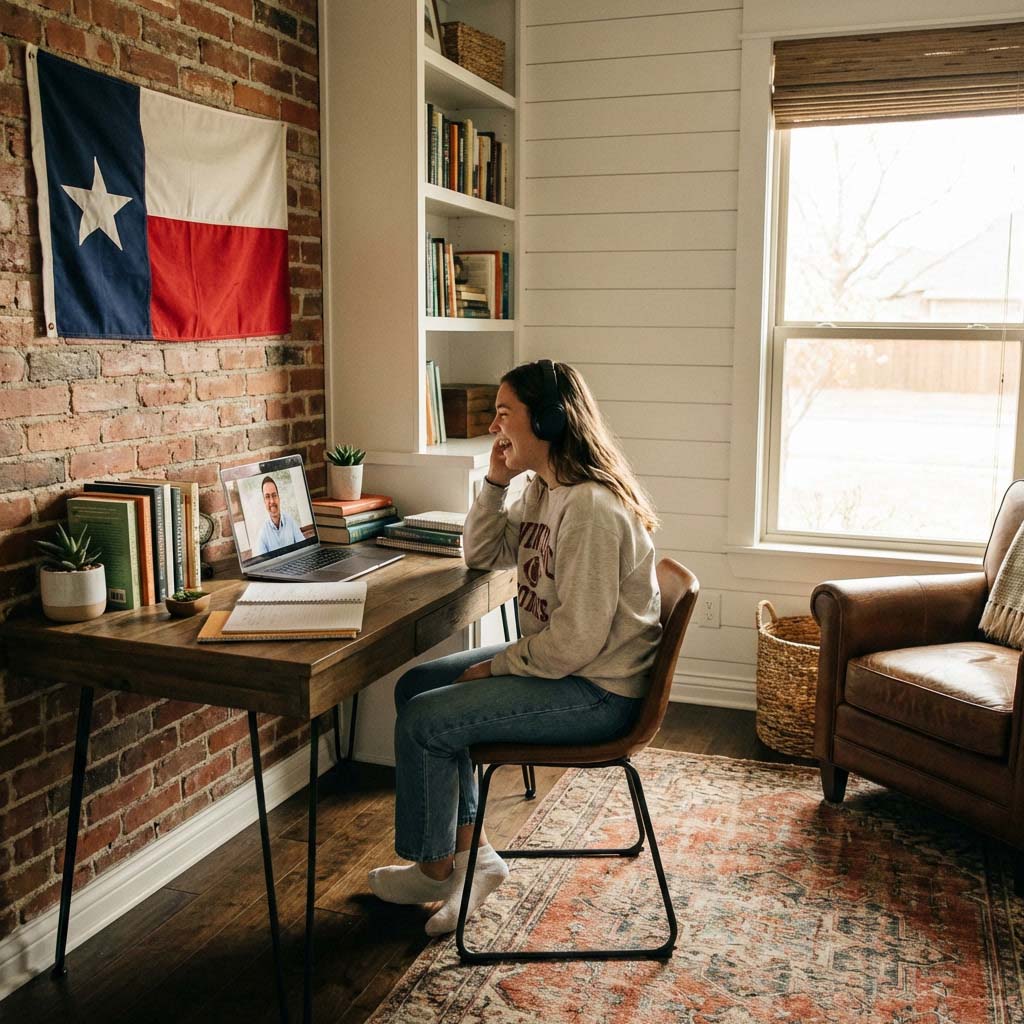
Accredited private online schools in Texas give students in grades 6 through 12 access to a rigorous, flexible education backed by recognized accreditation bodies like Cognia and SACS CASI.
These programs combine certified teacher-led instruction with the convenience of learning from home, and they're fully legal under Texas law, which treats private schools independently from the public system.
For Texas families weighing virtual education, the key is understanding what separates a high-quality accredited program from the growing crowd of online options available statewide.
Texas has seen an enormous shift toward virtual learning over the past decade. According to reporting from the Houston Chronicle and Government Technology, enrollment in full-time public virtual schools in Texas grew by 1,200% between 2014 and 2024, jumping from just under 5,000 students to nearly 62,200. That growth accelerated during and after the pandemic, but it hasn't slowed down. Families across the state are actively choosing online education not as a backup plan, but as a first choice.
But here's where it gets interesting: the majority of that growth has happened in public virtual schools, which are free but come with tradeoffs in class size, personalization, and individual attention. Private accredited online schools fill a different role entirely, offering smaller student-to-teacher ratios, dedicated academic support, and curriculum that's built around each student rather than the other way around.
Texas is one of the most hands-off states in the country when it comes to private education. The state does not regulate, accredit, or monitor private schools directly. According to the U.S. Department of Education's summary of Texas regulations, private schools in Texas must provide instruction in reading, spelling, grammar, mathematics, and good citizenship through a bona fide curriculum delivered in visual form. That's the baseline.
There's no state-mandated standardized testing for private school students, no requirement that teachers hold Texas teaching certificates, and no state approval process for curriculum. Accreditation is entirely voluntary, handled through agencies recognized by the Texas Private School Accreditation Commission (TEPSAC).
What does that mean for families? It means the regulatory framework gives private online schools a wide lane to operate in. But it also means accreditation status becomes one of the most important things to verify before enrolling. A school that voluntarily pursues and maintains accreditation through a recognized body like Cognia is demonstrating a commitment to academic quality that goes well beyond the state's minimum requirements.
Because Texas doesn't regulate private schools the way some other states do, accreditation serves as the primary quality marker for families evaluating accredited online school programs. Without it, there's no external check on a school's curriculum standards, teacher qualifications, or student outcomes.
Accreditation from a recognized regional body like Cognia (which incorporates the former SACS CASI) signals several things. The school has been evaluated against rigorous standards. Its curriculum meets or exceeds expectations for college preparation. Credits earned are widely transferable to other schools and recognized by colleges and universities. And for student athletes, attending a school with the right accreditation is often a prerequisite for NCAA eligibility.
Score Academy Online holds dual Cognia and SACS CASI accreditation and is NCAA Approved, which means students can compete at the collegiate level with confidence that their coursework meets NCAA requirements. That's a distinction worth paying attention to, especially for families with athletes who plan to pursue sports beyond high school. You can learn more about their accreditation on the Score Academy Online accreditation page.
Let's say you're a parent in Dallas, Houston, San Antonio, or Austin, and your child is entering 9th grade. You want them challenged academically, but the local high school has 35 students per class and your kid gets lost in the shuffle. An accredited private online school gives you something different.
At a school like Score Academy Online, class sizes run from one-on-one to a maximum of six students per teacher. Every student gets a dedicated teacher who knows them by name, understands their strengths and gaps, and builds instruction around an individualized education plan. That's not a marketing phrase. It's a structural feature of how the school operates.
Students attend live, scheduled classes with certified educators. They complete assignments, participate in discussions, take assessments, and receive real-time feedback. The school issues official transcripts, report cards, and a diploma upon graduation. In other words, it functions like a fully operational school with the added benefit that your child can attend from anywhere in Texas.
This is timely. Texas launched its Education Freedom Accounts (TEFA) program in 2025 under Senate Bill 2, with family applications opening in February 2026 for the 2026-27 school year. The program allocates $1 billion in state funds to provide education savings accounts to eligible families.
Students attending approved private schools can receive $10,474 per year toward tuition and education-related expenses. Students with disabilities who have an Individualized Education Program (IEP) may receive up to $30,000 annually. Homeschool students can receive up to $2,000.
Applications are prioritized based on household income and disability status, and a lottery is used if demand exceeds funding. But even for families who don't qualify for TEFA, the program's existence signals a major shift in how Texas views educational choice. It's no longer a fringe decision to enroll your child in a private school, whether physical or virtual. It's an option the state is actively funding.
For families considering accredited private online education, it's worth checking whether the school you're evaluating participates in the TEFA program, since approved schools must be accredited by an agency recognized by TEPSAC and must have operated a campus for at least two years.
Texas has 24 full-time public virtual schools operating statewide. They're free, which is a significant draw. But free doesn't always mean better fit.
Public virtual schools in Texas often operate with much larger class sizes. They follow TEA-mandated curriculum and testing requirements. Students are subject to state accountability measures, and schools themselves are rated based on aggregate performance data. That's not inherently bad, but it does mean less flexibility for students who need a different pace or structure.
A private online school operates outside those constraints. Curriculum can be more rigorous, more personalized, or more aligned with college preparation. Teachers can spend more time per student. And families get to choose based on fit rather than zip code.
The tradeoff, obviously, is cost. Private online schools charge tuition. Score Academy Online's tuition runs approximately $15,000 per year, with additional registration and technology fees bringing the first-year total to around $17,225. That's a meaningful investment, but it also comes with a level of individual attention and academic customization that most public virtual programs simply can't match.
A 2021 meta-analysis published in Education and Information Technologies examined 27 experimental studies across seven countries and found that online education had a moderate positive effect on academic achievement compared to traditional instruction, with an overall effect size of 0.409. The researchers noted that the effectiveness of online learning depended heavily on teacher preparation, learning design, and the use of digital tools to support engagement. (Read the full study here.)
That finding reinforces something families should keep in mind: the format of education matters less than the quality of instruction within that format. A well-designed online program with strong teacher involvement can match or outperform traditional classrooms, especially when it's paired with small class sizes and personalized learning plans.
Not every student is the right fit for online education, and that's okay. But the students who do well in this model share some common traits. They tend to be self-motivated (or have parents who provide structure early on). They benefit from flexible scheduling. And they often have interests or circumstances that make traditional school attendance difficult, whether that's competitive athletics, performing arts, chronic health conditions, frequent family relocations, or simply a preference for learning at their own pace.
Texas families with student athletes, military-connected children, kids dealing with anxiety or bullying, or gifted students who've outgrown their grade level are increasingly turning to online school as a practical solution. The variety of online school programs available in Texas means there's likely an option that fits, provided families take the time to evaluate accreditation, teacher quality, and student support.
When comparing programs, Texas parents should ask a few key questions. Is the school accredited by a body recognized by TEPSAC or a national/regional accreditor like Cognia? What are the class sizes? Are teachers certified and dedicated to their students, or is instruction largely self-paced with minimal teacher interaction? Does the school issue an accredited diploma? Are credits transferable? Is the school NCAA eligible if athletics matter to your family?
Beyond that, look at what kind of support structures are in place. Does the school offer individualized education plans? Is there academic advising? What happens when a student struggles? The answers to these questions tell you more about a school's quality than any marketing page ever will.
Score Academy Online checks those boxes with Cognia and SACS CASI dual accreditation, NCAA eligibility, class sizes of one-on-one to six-on-one, certified teachers, and personalized learning plans for every student in grades 6 through 12.
Is online school legal in Texas? Yes. Texas law allows private schools to operate independently of state regulation. Private online schools function as private schools under Texas law, which requires only that the curriculum be bona fide and cover reading, spelling, grammar, math, and good citizenship.
Are online school credits accepted by Texas colleges? Credits from accredited online schools are generally accepted by colleges and universities. Accreditation through a recognized body like Cognia ensures that transcripts carry the same weight as those from traditional brick-and-mortar schools.
Can Texas families use Education Freedom Accounts for online private school? Potentially, yes. The TEFA program provides up to $10,474 per student per year for approved private schools. The school must be accredited by a TEPSAC-recognized agency and have operated for at least two years. Families should verify whether their chosen school participates.
What's the difference between a public virtual school and a private online school in Texas? Public virtual schools are free and follow TEA curriculum and accountability requirements. Private online schools charge tuition but offer more flexibility, smaller class sizes, and personalized instruction. The right choice depends on your family's priorities and your child's needs.
How do I withdraw my child from public school to enroll in online school in Texas? Notify the school in writing that you're withdrawing your child. Texas law does not require a personal appearance, curriculum review, or approval from the district. Once withdrawn, you can enroll in the private online school of your choice.
Do online school students in Texas receive a real diploma? Students who attend an accredited online school receive an accredited diploma recognized by colleges, employers, and the military. Texas law considers the successful completion of a private school education equivalent to graduation from a public high school.
Learn what live online classes look like for K-12 students, how formats compare, why class size matters, and where to find a truly personalized option. Explore now.

Learn how self-paced online school works, who it fits best, and what accreditation and teacher involvement really mean before you choose a program.
Self-paced or live online school? This guide breaks down real differences, learning profiles, and how to find the right fit for your child. Start comparing now.