+1 (561) 295-3504



Pennsylvania families searching for an accredited online school have real options, but the quality gap between programs is wider than most parents realize.
An accredited private online school gives your child a recognized diploma, certified teachers, and small class sizes that large virtual public programs rarely offer.
Score Academy Online provides Cognia and SACS CASI dual accreditation, live classes with no more than six students per teacher, and individualized education plans for every student in grades 6 through 12.
Pennsylvania is considered one of the more heavily regulated states for alternative education, which means families need to understand how the law works before choosing a program. The good news is that enrolling in an accredited private online school is a fully legal and increasingly popular path. Here's what PA families need to know.
Pennsylvania's compulsory attendance law requires children to attend school from age 6 through age 18. Specifically, a child who turns six on or before September 1 must begin school that year, and attendance is mandatory until the student turns 18 or graduates from an accredited high school. This is governed by 24 P.S. § 13-1327 of the Pennsylvania School Code.
Families can satisfy this requirement through public school, a licensed or accredited private school, a home education program under Act 169, or instruction through a qualified private tutor. Enrolling in an accredited private online school falls under the private school pathway, and the state specifically recognizes that a child attending a school accredited by an approved accrediting association is considered to have met the compulsory attendance requirement.
This distinction matters. Pennsylvania draws a clear line between home education programs, which require annual affidavits, portfolio reviews, and standardized testing at designated grade levels, and private school enrollment, which shifts those responsibilities to the school. When a student enrolls in an accredited online school, the school handles transcripts, attendance records, assessments, and diploma issuance. For families who have been managing the administrative weight of homeschooling, this can be a significant relief.
Accreditation is the clearest signal that an online school meets established academic standards. In Pennsylvania, the distinction carries legal weight. Non-religious private schools must be either licensed by the state or accredited by an approved accrediting body. Religious schools can register through a separate affidavit process, but for families looking at non-sectarian online education, accreditation is the baseline requirement.
Score Academy Online holds dual accreditation from Cognia and SACS CASI. This means transcripts and diplomas are recognized by colleges and universities across the country, including Pennsylvania's state system (PASSHE), Penn State, the University of Pittsburgh, and private institutions throughout the Commonwealth. The school is also NCAA-approved, which is a factor for any student athlete planning to compete at the collegiate level. For a deeper understanding of why this matters, see our guide on accredited online school programs.
If a school can't produce a current accreditation certificate from a recognized body, that's a red flag. Credits earned at unaccredited institutions may not transfer, and diplomas may not be accepted by colleges or employers. In a state where the regulatory framework already distinguishes between accredited and non-accredited schools, choosing the former protects your child's academic future.
Pennsylvania doesn't operate a direct voucher program like some neighboring states, but it does offer the Educational Improvement Tax Credit (EITC) and the Opportunity Scholarship Tax Credit (OSTC). These programs allow Pennsylvania businesses and individuals to receive state tax credits for donations to approved scholarship organizations that fund private school tuition.
Families with a household income below $112,348 (plus $19,775 per child) may qualify for scholarships funded through the EITC program. The EITC allocates $263 million annually for K-12 scholarships, and the OSTC adds an additional $65 million. While these scholarships are distributed through approved scholarship organizations rather than directly by the state, they can meaningfully reduce tuition costs for qualifying families.
If you're considering a private online school and cost is a factor, it's worth contacting scholarship organizations in your area to ask about availability. The application process varies by organization, and credits are awarded on a first-come, first-served basis each fiscal year. For information about Score Academy Online's tuition structure, visit the tuition page to see what's included.
The difference between online schools often comes down to something simple: how much attention your child actually gets. A 2024 study published in Frontiers in Psychology analyzed data from 21,903 schools across 80 countries using the PISA database and found that class size has a significant non-linear effect on student outcomes, with a critical threshold of 27 students per class. Beyond that point, academic preparedness became increasingly unpredictable (Antoniou, Alghamdi, & Kawai, 2024). The study confirmed that smaller classes allow teachers to use varied instructional strategies and accommodate different learning styles more effectively.
Score Academy Online keeps class sizes between one and six students. That's well below any research threshold, and it means every student gets sustained, meaningful interaction with certified teachers throughout the school day. Each student also receives an individualized education plan that adjusts based on their pace and areas of strength or challenge.
Beyond class size, families should evaluate curriculum depth. Does the school offer honors and AP-level courses? Are electives available across subject areas? Can a student build a transcript that reflects readiness for competitive college admissions? For a broader comparison of what private online schools provide, see our article on private online schools: benefits, costs, and what to know.
Imagine a student in Pittsburgh who trains competitively in figure skating and needs a schedule that accommodates early morning ice time and travel for competitions. A traditional school calendar simply can't flex around that. Or consider a family in a rural part of the state where the nearest high school offers limited course options and no AP classes. Online school brings the full curriculum to the student regardless of geography.
Students who struggle with anxiety, bullying, or chronic health conditions often find that removing the social pressure of a physical school building lets them focus on learning. Gifted students who feel held back by the pace of a traditional classroom can move through material more quickly and take on more advanced coursework.
Pennsylvania military families stationed at bases like Carlisle Barracks or the former Willow Grove reserve site also benefit from the continuity that an online school provides. When a PCS move happens, the student's school stays the same. Whether your student is in middle school or finishing up high school, a private online school adapts to their situation rather than the other way around.
If your child is currently in a Pennsylvania public school, you'll need to formally withdraw them by notifying the school in writing. Pennsylvania does not require families to get approval from the school district before leaving. You notify the school, provide documentation of your child's new enrollment, and the transition is complete.
For families currently homeschooling under Act 169, moving to an accredited private school means you no longer need to submit the annual affidavit to your school district superintendent, maintain a portfolio for review, or arrange for an independent evaluation by June 30 of each year. The school takes over those responsibilities once enrollment is finalized.
Mid-year transfers are possible with private online schools that offer rolling enrollment. If your student is struggling and you don't want to wait for the next academic year to make a change, this flexibility matters. For a full look at what daily life in online school involves, see our article on how online school works.
Enrollment at Score Academy Online begins with an application and an introductory conversation with the admissions team about your student's history, goals, and learning needs. From there, the school creates a plan built around your child. With live instruction, certified teachers, and a diploma backed by dual Cognia and SACS CASI accreditation, it's an education built for students who need more than a one-size-fits-all approach.
Whether you're in Philadelphia, the Lehigh Valley, Central PA, or the western part of the state, an accredited online school puts a personalized education within reach.
Is online school legal in Pennsylvania? Yes. Pennsylvania's compulsory attendance law recognizes enrollment in an accredited private school as a valid way to satisfy the attendance requirement. An accredited private online school qualifies under this provision, making it a fully legal option for families across the Commonwealth.
What ages does Pennsylvania's compulsory attendance law cover? Children must attend school from age 6 (if they turn 6 on or before September 1 of that school year) through age 18. The requirement ends when the student either turns 18 or graduates from an accredited high school, whichever comes first.
Can Pennsylvania families get financial help for private online school tuition? Pennsylvania offers the Educational Improvement Tax Credit (EITC) and Opportunity Scholarship Tax Credit (OSTC) programs, which fund scholarships for eligible families through approved scholarship organizations. Eligibility depends on household income, and awards are distributed on a first-come, first-served basis. Contact a local scholarship organization to check availability.
How do I withdraw my child from public school in Pennsylvania? Notify your child's school in writing that you are withdrawing them and provide proof of enrollment in a new educational program. Pennsylvania does not require school district approval for the withdrawal. Once the paperwork is complete and your child is enrolled in their new school, the transition is finalized.
Will Pennsylvania colleges accept an online school diploma? Yes, as long as the online school holds recognized accreditation. Score Academy Online's Cognia and SACS CASI accreditation means its transcripts carry the same weight as those from any accredited private school. PASSHE universities, Penn State, and private institutions throughout Pennsylvania accept transcripts from Cognia-accredited schools.
What grades does Score Academy Online offer for Pennsylvania students? Score Academy Online serves students in grades 6 through 12, covering both middle school and high school. There is no elementary program. The school is designed specifically for students entering sixth grade or older.
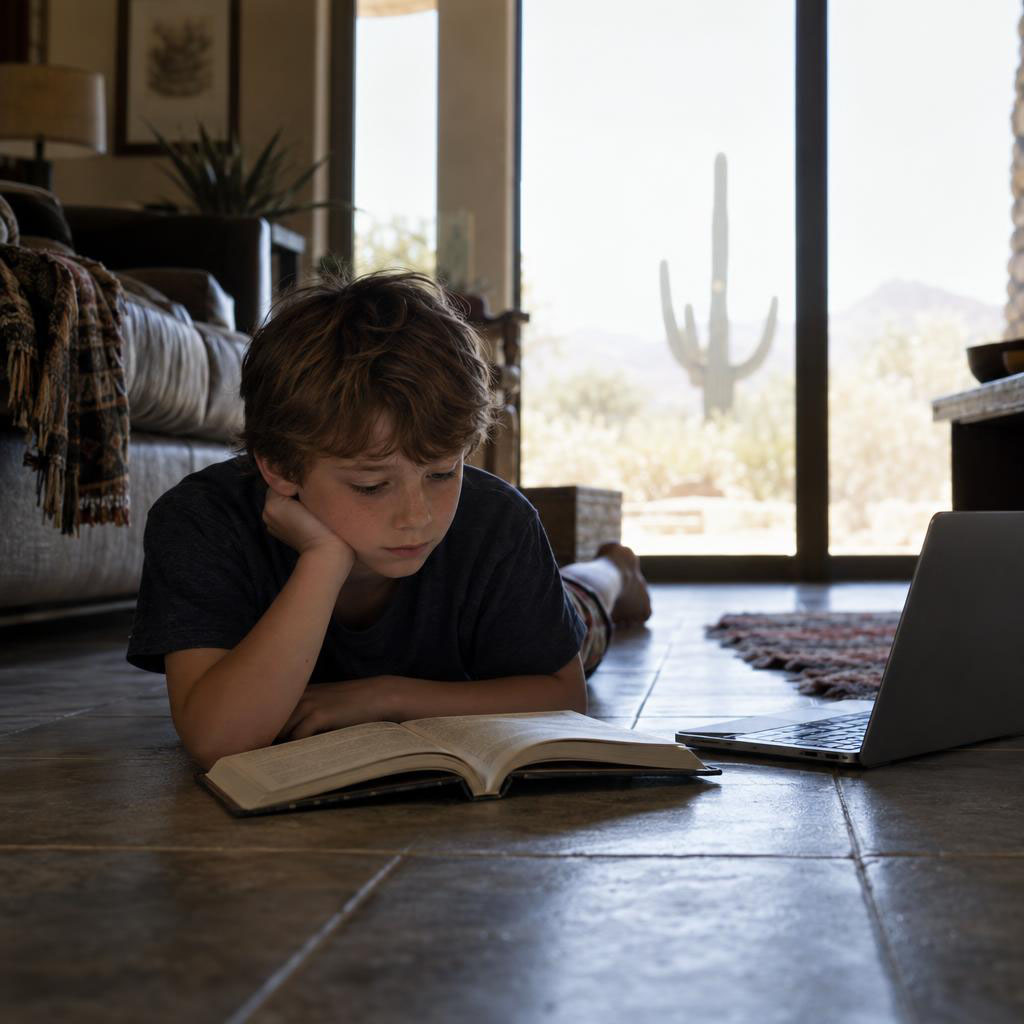
Online elementary school in Arizona: accredited options, how the universal ESA helps pay tuition, and what to look for when choosing a program for K-5.

An online elementary school curriculum covers reading, math, science, and social studies across grades K-5. Here's what students learn and how it's taught.
Learn what live online classes look like for K-12 students, how formats compare, why class size matters, and where to find a truly personalized option. Explore now.