+1 (561) 295-3504



If you're a Michigan parent researching accredited online school options for your child in grades 6 through 12, you have clear legal footing.
Michigan's compulsory attendance law provides two separate pathways for educating children outside the public school system, and both accommodate enrollment in a private online program.
There's no state standardized testing requirement for privately educated students, no mandated number of school days, and no state curriculum that must be followed word for word. What matters is that your child receives instruction in the required subject areas from an organized educational program.
That flexibility is driving more Michigan families toward virtual learning. Whether the motivation is a schedule that conflicts with traditional school hours, an academic environment that better fits how your child learns, or simply the desire for smaller classes and more personal attention, an accredited online school can deliver what many Michigan districts cannot.
Michigan's compulsory attendance statute (MCL 380.1561) requires children from age 6 through 18 to attend school. The law provides two exemptions for families choosing to educate at home. Under exemption (3)(a), a child may attend a state-approved nonpublic school that teaches subjects comparable to those in the public schools. Under exemption (3)(f), a parent or legal guardian may educate the child at home in an organized program covering reading, spelling, mathematics, science, history, civics, literature, writing, and English grammar.
Both pathways work for families enrolling in a private online school. The nonpublic school route offers access to additional services, including the ability for students to enroll in elective courses at their local public school and eligibility for state-funded dual enrollment at postsecondary institutions. There are no mandatory standardized tests under either option, no required number of instructional hours, and no obligation to follow a state-prescribed curriculum beyond the listed subject areas.
Michigan's constitution does include a Blaine amendment that prohibits direct public funding of private school tuition, which means the state currently offers no voucher, tax-credit scholarship, or education savings account program. A new federal tax-credit scholarship program signed into law in 2025 could eventually provide support, but Michigan would need to opt in before families could access those funds beginning in 2027.
Michigan's public schools vary widely in quality. While suburban districts around Ann Arbor, Birmingham, and Grand Rapids consistently rank among the state's strongest, many urban and rural communities face challenges with funding, staffing, and student outcomes. For families in districts where class sizes are large and individualized support is limited, online school offers a meaningful alternative.
A 2024 study published in Frontiers in Psychology analyzed data from over 21,000 schools across 80 countries and identified a class size of 27 students as a critical threshold beyond which academic outcomes become significantly less predictable (Antoniou, Alghamdi, & Kawai, 2024). Many Michigan classrooms exceed that number, particularly at the secondary level.
Beyond academics, families turn to online school for practical reasons. Consider a high school student in the Grand Rapids area who trains year-round for competitive hockey. Between daily ice time, strength conditioning, and weekend tournaments, a rigid school-day schedule creates constant conflicts. In an online school, that student attends live classes in focused blocks, completes coursework around training, and still earns an accredited diploma without sacrificing either pursuit.
Other families seek online school when anxiety, bullying, chronic illness, or learning differences make a traditional campus counterproductive. Removing the stressor isn't giving up on education. It's clearing the path to it.
Accreditation is the single most important factor when choosing an online school. Regional accreditation from a body like Cognia (formerly AdvancED and SACS CASI) means the school has been independently verified to meet rigorous academic standards. It also means your child's transcript, credits, and diploma will be recognized by colleges, universities, employers, and the NCAA.
Beyond accreditation, look at class size. A program that caps classes at just a few students per teacher can provide individualized attention that large district classrooms cannot match. Look for certified teachers in every course, not facilitators monitoring self-paced modules. And ask whether the school builds individualized education plans for all students, not only those with documented learning differences.
Score Academy Online meets all of these criteria. It's a Cognia-accredited, NCAA-approved private online school serving grades 6 through 12, with live classes capped at six students per teacher. Every student receives an individualized education plan, and all courses are taught by certified educators.
Michigan offers several alternatives to traditional public school, and understanding the differences helps clarify where private online education fits.
Homeschooling is straightforward in Michigan, but it places curriculum planning, instruction, and assessment entirely on the parent. A private online school offers the same at-home learning environment with the structure of certified teachers, live scheduled classes, and an accredited diploma. For a closer comparison, this article on online school vs. homeschool differences explains what changes and what stays the same.
Michigan does have a robust charter school sector, particularly in Detroit and other urban areas, but charter schools are public schools with set schedules and physical attendance expectations. Michigan Virtual offers individual online courses that public and nonpublic school students can take, but it is not a full-time school and does not grant diplomas.
For families who want a complete, accredited virtual education with small classes and personal attention, private online school fills a gap that Michigan's public options leave open.
Enrolling in a private online school from Michigan requires no state approval. If your child is currently in a public school, formally withdrawing them is recommended to prevent truancy concerns. After withdrawal, enrollment is handled directly through the online school.
Most accredited programs, including Score Academy, accept students on a rolling basis. Credits from your child's previous school typically transfer as part of the admissions process, and mid-year starts are common. For a closer look at what accredited online high school programs offer, this guide on accredited online high schools covers the essentials.
Is online school legal in Michigan? Yes. Michigan's compulsory attendance law (MCL 380.1561) allows children to attend a nonpublic school or be educated at home in an organized educational program. Enrolling in an accredited private online school satisfies either pathway.
Do I need to notify my school district? If your child is currently enrolled in a public school, formally withdrawing them is strongly recommended. Under the homeschool exemption (3)(f), there is no notification requirement, but failing to withdraw can trigger truancy questions.
Will colleges accept a Michigan online school diploma? Yes, provided the school is accredited. A diploma from a Cognia-accredited program like Score Academy Online carries the same recognition as one from any accredited brick-and-mortar school.
Are there financial assistance options for Michigan families? Michigan currently has no state voucher or tax-credit scholarship program due to its constitutional Blaine amendment. A new federal tax-credit scholarship program could provide future support if Michigan opts in. Families should inquire directly with their chosen school about payment plans.
What grades does Score Academy Online serve? Score Academy Online serves students in grades 6 through 12 with live, teacher-led classes capped at six students. Every student receives an individualized education plan.
Can Michigan online school students take classes at their local public school? Under the nonpublic school pathway, Michigan law allows students to enroll in nonessential elective courses at their resident public school, including AP classes. Participation in interscholastic athletics is at the discretion of the local district.
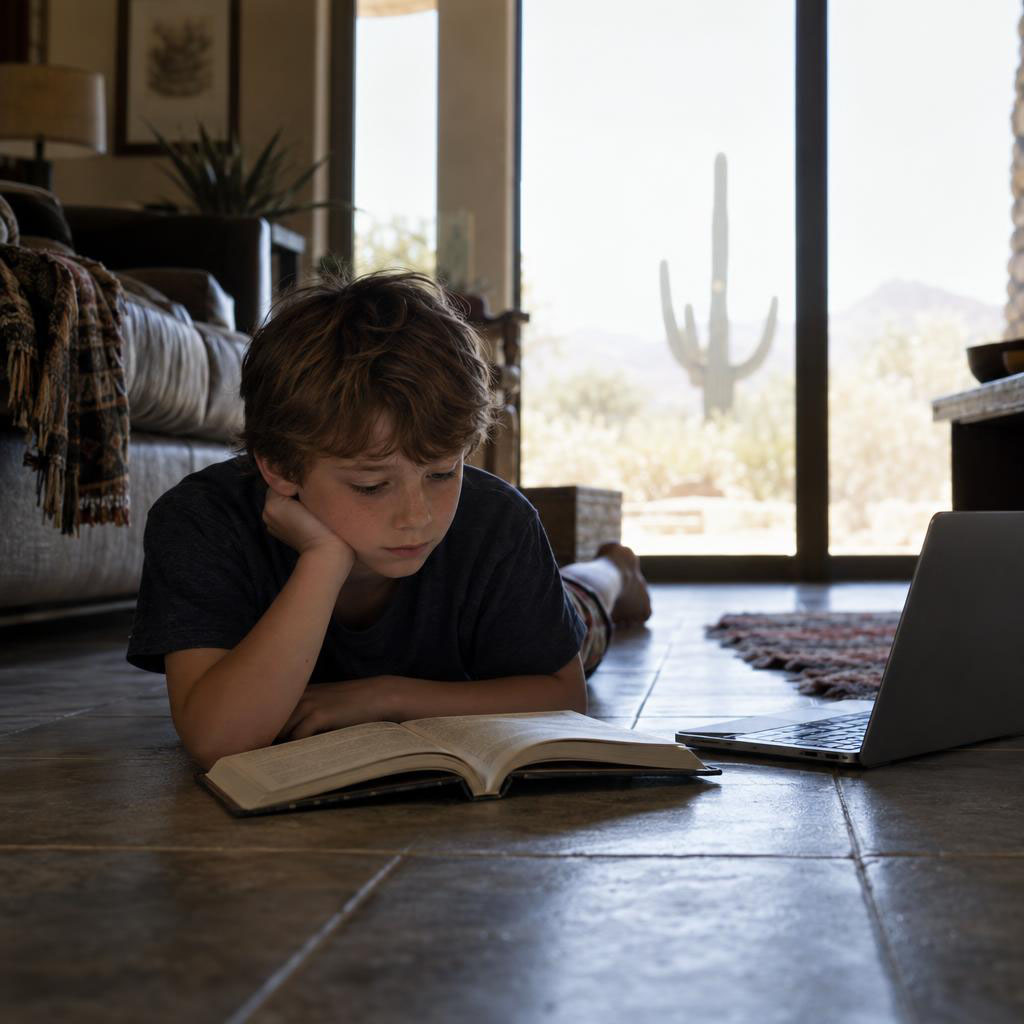
Online elementary school in Arizona: accredited options, how the universal ESA helps pay tuition, and what to look for when choosing a program for K-5.

An online elementary school curriculum covers reading, math, science, and social studies across grades K-5. Here's what students learn and how it's taught.
Learn what live online classes look like for K-12 students, how formats compare, why class size matters, and where to find a truly personalized option. Explore now.