+1 (561) 295-3504


Parent guide · Grades K–12 · All 50 states
Homeschooling means the parent directs the education, chooses the curriculum, and follows the home education law in their state. This guide covers how it works, what it costs, the rules in your state, and how homeschooling differs from an accredited online school like Score Academy Online.
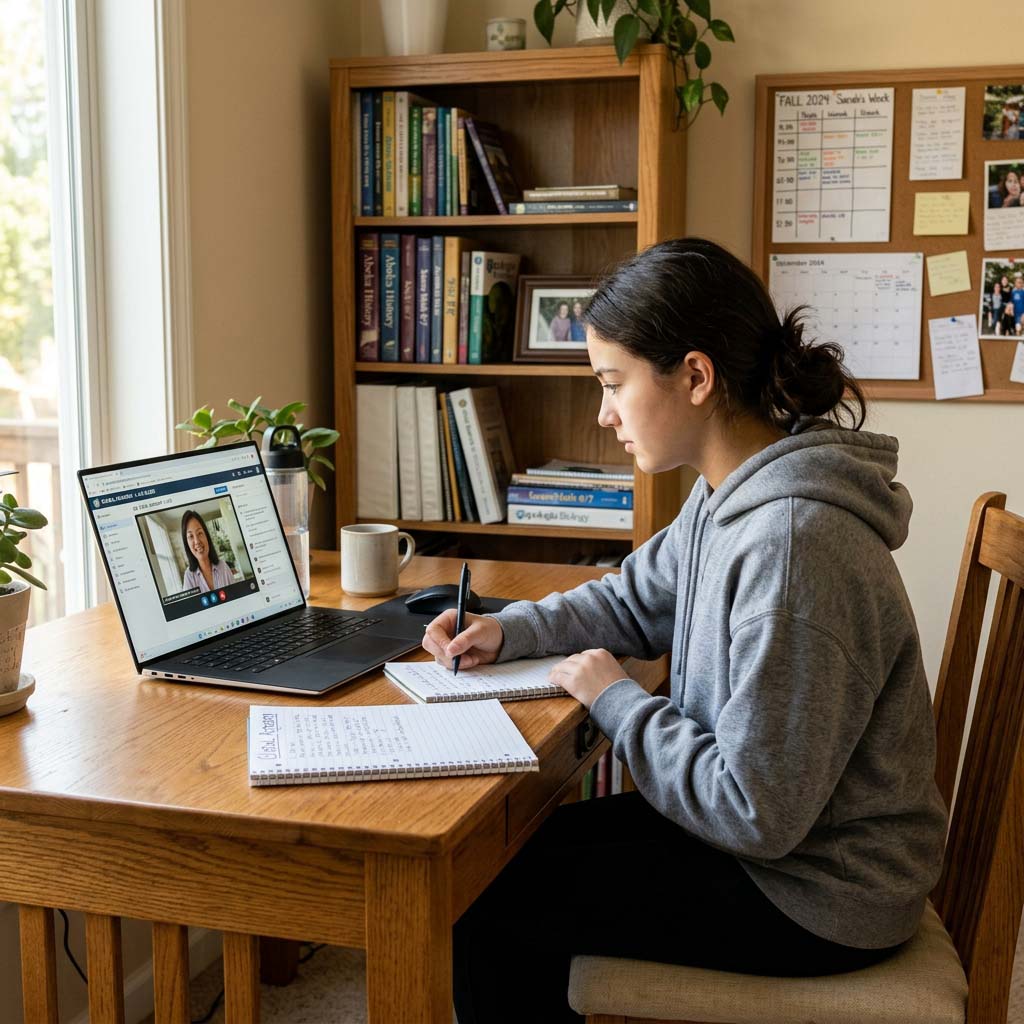
Homeschooling is a parent-directed form of education where the parent or guardian, rather than a school, takes legal responsibility for a child's instruction at home. The parent selects the curriculum, delivers or arranges the teaching, tracks progress, and complies with their state's home education law. Every state allows it, but the rules differ significantly from one state to the next.
This is the point most families get tangled up on, so it is worth being precise. Homeschooling is not the same as an accredited online school. In an accredited online school, the school employs certified teachers, provides the curriculum and instruction, grades the work, and issues an accredited transcript and diploma. In homeschooling, the parent carries all of that responsibility. Both happen at home, which is exactly why the terms get used interchangeably, but the day-to-day experience, the paperwork, and the credential at the end look completely different. We break the two apart in detail in our guide to online school versus homeschool.
According to the National Center for Education Statistics, about 5.2% of children ages 5 to 17 received academic instruction at home during the 2022–23 school year, up from 3.7% in 2018–19 (NCES, September 2024). A Pew Research Center analysis of the same federal data found that 3.4% of students were homeschooled, while a separate 1.8% attended full-time virtual public or private schools, roughly double the pre-pandemic share (Pew Research Center, February 2025).
The mechanics vary by state, but the path to starting a homeschool almost always follows the same five steps. Read your state's rules first, because the details in steps two through five change depending on where you live.
Compulsory attendance ages, filing requirements, recordkeeping, and evaluation rules are all set at the state level. Start with your state's guide below so you know exactly what applies before you withdraw a child from school.
Many states ask you to file a notice of intent, an affidavit, or an enrollment notice with your school district or county superintendent before or shortly after you begin. Some states require nothing at all.
You can build your own program, buy a boxed curriculum, use online courses, or combine methods. This is the part parents have the most freedom over, and the part that carries the most responsibility.
Depending on the state, this can mean a portfolio of work samples, an attendance log, or nothing formal. Good records also make college applications and any future school transfer far smoother.
Some states require an annual evaluation or standardized test to show academic progress. Others never check in. Your state guide spells out what, if anything, is due each year.
Homeschooling costs range widely because the parent controls the spending. Families who lean on free and library resources spend very little, while families who buy full curricula, tutoring, and enrichment spend more. The bigger lever for most families today is public funding, which has expanded rapidly through Education Savings Accounts and scholarships.
An Education Savings Account (ESA) is a state-funded, parent-controlled account that deposits public money families can spend on approved educational expenses, including curriculum, tutoring, and in many cases private school tuition. States including Arizona, New Hampshire, and Alabama run these programs, often paid out through a platform called ClassWallet. Florida families use a related set of scholarships, the Family Empowerment Scholarship and the Florida Tax Credit Scholarship, administered through Step Up For Students.
One rule trips up a lot of families: in most states, ESA participation is a separate legal category from homeschooling. If you sign an ESA contract, you often stop being classified as a homeschooler and no longer file the usual homeschool paperwork. We map every funding route, state by state, on our Education Savings Accounts and school choice pages.
If you like the idea of learning from home but do not want to teach the material or manage the paperwork yourself, an accredited online school is a different route to the same flexibility. Here is how the two compare on the things parents ask about most.
| Homeschooling | Accredited online school | |
|---|---|---|
| Who teaches | The parent selects curriculum and delivers or arranges instruction | Certified teachers provide instruction and grade the work |
| Curriculum | Chosen and assembled by the parent | Provided by the school |
| Transcript and diploma | Parent-created; may need extra documentation for college | Accredited transcript and diploma colleges recognize |
| State paperwork | Notice, recordkeeping, and evaluations handled by the parent | Enrollment in the school satisfies compulsory attendance |
| Best for | Families who want full control over what and how a child learns | Families who want home flexibility with teachers and an accredited credential |
Score Academy Online is an accredited online private school, not a homeschool curriculum. It is Cognia accredited and offers NCAA-approved courses for grades K–12, with real teachers, live and flexible learning options, and an accredited transcript. For many families the appeal is simple: the flexibility of learning at home, without carrying the teaching load or the compliance paperwork yourself. Explore the curriculum or see how enrollment works.
Homeschooling rules are set state by state, so this is where the real detail lives. Start with your state below for the compulsory ages, filing steps, recordkeeping, and the funding available where you live.
Guides for every state are rolling out. Do not see yours yet? Ask admissions and we will point you to the rules where you live.
No. Online school and homeschool are legally and practically different. In an accredited online school, students are enrolled in an institution with certified teachers who provide instruction and issue an accredited transcript. In homeschooling, the parent directs the education and selects the curriculum. Both happen at home, which is why the terms get confused, but the responsibilities and the credential differ.
It depends on the state. Many states require a one-time notice, affidavit, or enrollment form filed with your school district or county. Some require annual notice or evaluations, and a handful require nothing at all. No state requires you to get permission to homeschool, but most require some form of notification. Check your state guide for the exact step.
Costs vary widely because parents control the spending, from very little using free and library resources to a few thousand dollars a year for full curricula, tutoring, and enrichment. Many families now offset costs with a state Education Savings Account or scholarship, where available. See our funding guide for what is offered in your state.
Yes. Colleges routinely admit homeschooled students. The main difference is documentation: homeschool families create their own transcripts and often supplement with standardized test scores, while students from an accredited school receive a recognized transcript automatically. Neither path blocks college admission when the coursework is solid.
In many states, yes. Education Savings Accounts and scholarships can often be directed toward tuition at an approved private school, including an accredited online school. Because enrolling in a school is usually a separate legal category from homeschooling, this can also remove the homeschool paperwork. Score Academy Online works with several of these programs. See our Education Savings Accounts page for details by state.
Yes. Homeschooling is legal in all 50 states and the District of Columbia. What changes from state to state is the level of regulation, from states that require almost nothing to states that require notice, recordkeeping, and annual evaluations.
Score Academy Online gives families the flexibility of learning at home with certified teachers, accredited courses for grades K–12, and a transcript colleges recognize. Talk to admissions about whether it fits your child, or explore the curriculum first.