+1 (561) 295-3504


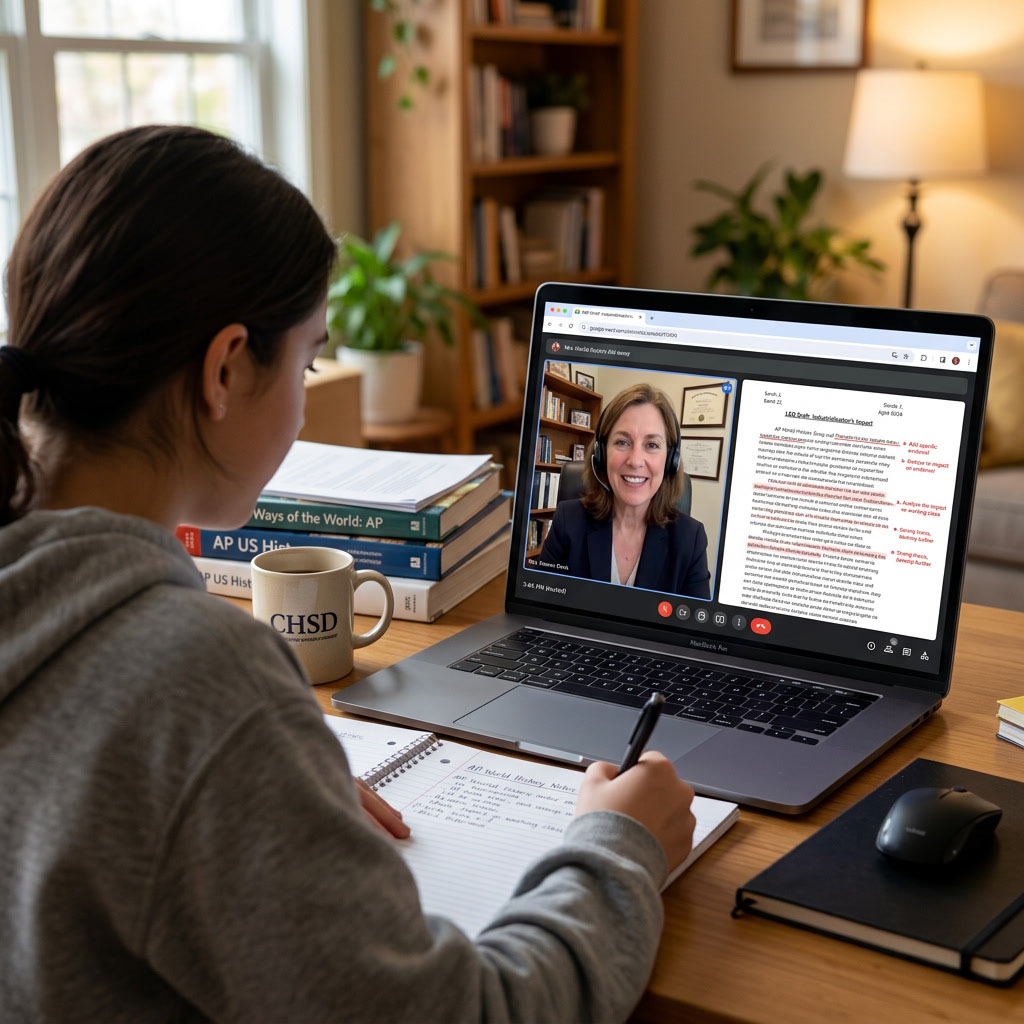
Advanced Placement courses are available at accredited online schools, and students who enroll in these programs can earn college credit, strengthen their transcripts, and build the academic profile colleges want to see. If you're wondering whether your child can access rigorous AP coursework through a virtual school, the answer is yes. Programs like Score Academy Online offer live, teacher-led instruction with a maximum of six students per class, giving AP students the kind of focused attention that's often missing in traditional schools where AP sections can exceed 30 students.
For parents weighing online education options, understanding how AP courses work in a virtual setting, which subjects are available, and how colleges view these credits is essential to making a confident enrollment decision.
The Advanced Placement program, administered by the College Board, allows high school students to take college-level coursework while still in secondary school. Students who score well on the corresponding AP exam (scored on a scale of 1 to 5) may receive college credit, advanced placement into higher-level courses, or both, depending on the policies of their chosen college or university.
AP courses matter for several reasons. They demonstrate academic ambition and readiness for college-level rigor. They can reduce the total number of credits a student needs to complete in college, potentially saving both time and tuition money. And they carry significant weight in college admissions. According to the College Board, roughly 85% of selective colleges and universities look favorably on applicants with AP experience on their transcripts.
Beyond admissions, AP participation has been linked to stronger college performance. Research consistently shows that students who earn qualifying scores on AP exams tend to achieve higher GPAs in college and demonstrate greater persistence through graduation. While the size of these benefits varies based on individual circumstances, the pattern is clear: AP experience signals preparation for what comes next.
One of the most common concerns parents express about online schooling is whether the academic rigor matches what students would experience in a physical classroom. With AP courses, the curriculum itself eliminates that concern. Every AP course follows a standardized framework set by the College Board, regardless of where or how it's taught. The content, learning objectives, and exam preparation are the same whether a student sits in a classroom in suburban Texas or logs in from a home office in Connecticut.
What differs, and what often gives online AP students an advantage, is the learning environment. At Score Academy Online, classes are Cognia-accredited and capped at six students. That means an AP student isn't competing with 25 or 30 classmates for the teacher's attention during a complex lesson on AP Chemistry equilibrium equations or AP U.S. History document-based questions. Instead, they're part of a small, focused group where the teacher can adjust pacing, provide immediate feedback, and address individual knowledge gaps as they arise.
Research supports the idea that smaller learning environments improve academic outcomes. A 2024 study published in Frontiers in Psychology analyzed data from over 21,000 schools across 80 countries and found that class size has a significant impact on both the educational experience students have and the academic results they achieve. The study noted that teachers in smaller courses are better at using varied instructional strategies, accommodating different learning styles, and maintaining the kind of productive classroom environment where advanced coursework thrives.
The College Board currently offers more than 35 AP courses across six subject areas: English, History and Social Sciences, Math and Computer Science, Sciences, World Languages and Cultures, and Arts. Online schools can offer any AP course that meets the College Board's audit requirements and appears on the official AP Course Ledger.
Common AP courses available through online schools include:
AP English Language and Composition, AP English Literature and Composition, AP U.S. History, AP World History: Modern, AP Government and Politics, AP Calculus AB and BC, AP Statistics, AP Biology, AP Chemistry, AP Physics, AP Psychology, AP Computer Science A, AP Computer Science Principles, AP Environmental Science, AP Spanish Language and Culture, and AP Art History, among others.
The specific AP offerings vary by school. When evaluating an online school, parents should confirm which AP courses are available and whether the school holds College Board authorization for those courses. Schools that appear on the AP Course Ledger have undergone an audit process confirming their curriculum aligns with College Board standards.
Score Academy Online builds individualized education plans for every student, which means AP course selection isn't a one-size-fits-all process. A student preparing for pre-med can prioritize AP Biology and AP Chemistry, while a future economics major might focus on AP Macroeconomics and AP Calculus. That kind of strategic course planning, done in partnership with teachers and advisors, gives students a meaningful advantage when it's time to apply to college.
Parents sometimes worry that colleges will view AP courses taken at an online school differently than those completed at a brick-and-mortar institution. The reality is straightforward: colleges evaluate AP performance primarily based on exam scores. A score of 4 or 5 on an AP exam carries the same weight regardless of where the student studied the material.
Most U.S. colleges and universities offer credit or advanced placement for qualifying AP scores. Public universities tend to accept scores of 3 and above, while more selective private institutions often require a 4 or 5. Some highly selective schools, such as those in the Ivy League, have moved toward using AP scores for placement rather than awarding direct course credit. This means a student might skip an introductory class and enroll in a more advanced section, even if the credits don't formally reduce their graduation requirements.
The transcript matters too, and this is where accreditation becomes critical. A Cognia-accredited online school produces transcripts that colleges recognize and trust. Because Score Academy Online is also NCAA-approved, student athletes pursuing college sports can count their AP courses toward eligibility requirements.
In many traditional high schools, AP classes are among the largest in the building. Schools often have one or two AP sections per subject, and demand pushes enrollment well above 25 students. That creates a challenging dynamic: the curriculum is college-level, but the support structure is stretched thin.
Online schools that cap class sizes change that equation entirely. With a maximum of six students per AP class at Score Academy Online, the teacher-to-student dynamic looks more like a college seminar than a crowded lecture hall. Students can ask questions without hesitation, engage in meaningful discussions about complex material, and receive the kind of detailed feedback on essays, problem sets, and lab reports that's nearly impossible when a teacher is responsible for 150 AP students across multiple sections.
This structure is particularly beneficial for students who are new to AP coursework. A 9th grader taking their first AP course benefits enormously from a teacher who can recognize when they're struggling with the transition from standard to college-level expectations. Similarly, a junior balancing three AP courses alongside SAT prep and extracurriculars gets a more manageable experience when each class offers genuine one-on-one support.
Successful AP students don't just pick courses at random. They build a multi-year strategy that balances challenge with manageability, aligns with their academic interests, and strengthens their college application narrative.
A typical progression might begin in 9th or 10th grade with one AP course in a subject where the student has strong foundational skills. AP Human Geography and AP World History: Modern are popular starting points because they introduce AP-style thinking and assessment without assuming extensive prerequisite knowledge. By 11th grade, students often take two or three AP courses, building toward a peak of academic intensity. 12th graders can then round out their transcript with AP courses that reflect their intended college major or intellectual curiosity.
Working with an online school that creates individualized education plans allows families to map out this progression from the start. Rather than fitting a student into whatever sections happen to have openings, the academic team at a school like Score Academy Online can design a course sequence that makes strategic sense for each student's goals.
AP exams are administered in May at designated testing centers. Online school students register for exams the same way traditional students do, either through their school's AP coordinator or by connecting with a local testing site. The exams themselves are identical regardless of where the student prepared for them.
Preparation in an online setting often includes regular practice with AP-style questions, timed essay writing, and review of released exam materials. Because online schools aren't bound by bell schedules and passing periods, teachers have more flexibility to dedicate extra time to exam review sessions, hold office hours for targeted help, and adjust the pacing of content delivery so students feel genuinely ready by May.
Students who have taken AP courses in small online classes frequently report feeling more prepared than peers who studied in larger traditional settings. The consistency of direct teacher interaction throughout the year means fewer surprises on exam day.
Yes. Accredited online schools can offer AP courses that are fully authorized by the College Board. Students complete the same curriculum, access AP Classroom resources, and sit for the same exams as students at traditional schools. Programs like Score Academy Online provide live, teacher-led AP instruction in small class settings.
Colleges evaluate AP performance based on exam scores, not where the course was taken. A qualifying score on an AP exam earns the same credit or placement whether the student prepared at a traditional high school or an accredited online school. The key is ensuring the online school holds recognized accreditation, such as Cognia accreditation.
There's no universal answer, but most college admissions experts recommend a strategic approach rather than maximizing the number of AP courses. Starting with one AP course in 9th or 10th grade, building to two or three in 11th grade, and taking courses that align with the student's interests and intended major tends to produce the strongest applications and outcomes.
Most colleges require a score of 3, 4, or 5 on the AP exam to award credit or placement. Public universities often accept scores of 3, while selective private institutions typically require a 4 or 5. Credit policies vary significantly by school and by subject, so families should check individual college AP policies through the College Board's credit policy search tool.
AP courses follow the same College Board curriculum regardless of the school format. The difficulty of the material is identical. What changes is the support structure. At online schools with small class sizes, students often receive more individualized attention and support, which can make the challenging material more manageable.
For families seeking rigorous AP instruction with small class sizes, individualized attention, and strategic college prep guidance, a private online school can be a strong investment. The combination of college-level coursework, direct teacher support, and a recognized accredited transcript creates a foundation that pays dividends during college admissions and beyond.

How many credits to graduate high school? Most states require 20 to 24 credits across English, math, science, and social studies. See the state-by-state guide.

Online elementary school in Arizona: accredited options, how the universal ESA helps pay tuition, and what to look for when choosing a program for K-5.

An online elementary school curriculum covers reading, math, science, and social studies across grades K-5. Here's what students learn and how it's taught.