+1 (561) 295-3504


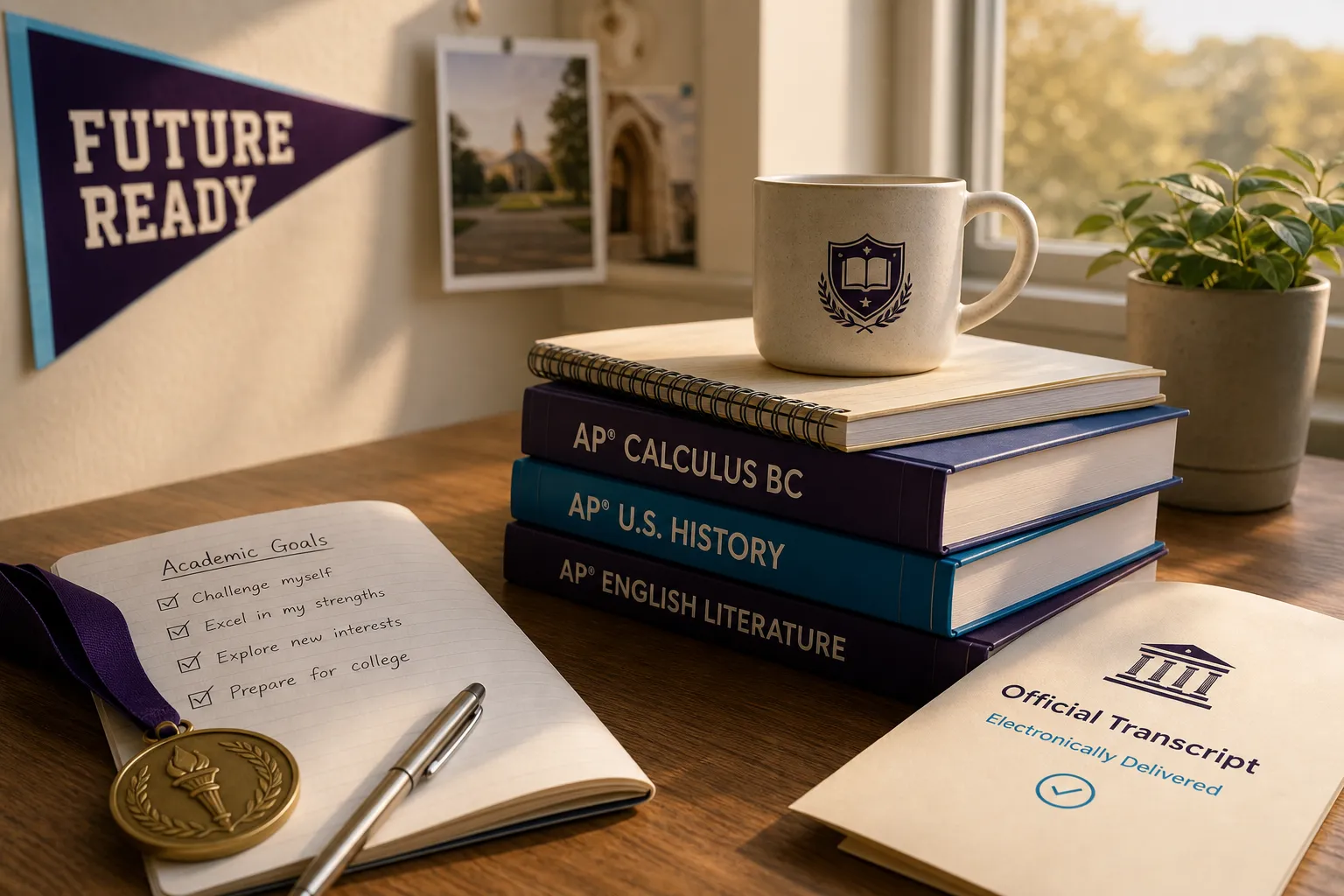
Building a competitive college transcript online takes more than earning good grades, it requires deliberate course choices, consistent grade trends, and careful transcript delivery. Admissions readers at selective colleges don't evaluate grades in a vacuum. They weigh how hard the courses were, how grades trended over four years, and whether the student sought out genuine academic challenge. That distinction matters: a competitive college transcript isn't built in easy classes. It's built through sustained, strategic decision-making from freshman year through the final semester.
This article covers both sides of the transcript conversation: the strategic side (what goes on the record and why it matters) and the logistical side (how to order and send your official transcript electronically once it's time to apply). Students at Score Academy Online build exactly this kind of record, with Cognia-accredited transcripts, 15+ AP courses, and certified teachers grading every assignment. The principles here, though, apply to any student who wants a stronger application file.
Selective college admissions readers evaluate transcripts on two dimensions simultaneously: how strong the grades are and how hard the courses were. Strong grades in unchallenging courses don't tell the story competitive programs want to see. What they're looking for is evidence that a student sought out difficulty and succeeded anyway.
GPA matters, but never in isolation. At schools with acceptance rates under 25%, admitted students often cluster in the 3.7 to 4.0 unweighted GPA range, according to Common Data Sets published by those institutions. A higher GPA in standard-level courses can actually be less persuasive than a somewhat lower GPA earned across a full slate of AP and honors classes. The number on the page gets weighted against the course load behind it and against what the student's school actually offered.
Grade trends carry real weight as well. Admissions readers follow a student's trajectory year by year, looking for consistency or improvement. An upward trend, especially through junior and senior year, can offset a rough earlier semester. A downward trend, even from an otherwise strong GPA, raises questions about whether the student can sustain performance under pressure. The transcript tells a story. The goal is to make sure it's a compelling one.
AP courses are the clearest signal of academic ambition available on a high school transcript. When a student takes AP coursework, they're showing admissions readers they were willing to attempt college-level work before stepping foot on campus. The number of AP courses a student completed is always evaluated against what their school offered. A student who took six AP courses at a school that offered eight looks very different from one who took six at a school that offered twenty.
Nationally, roughly 82% of college freshmen from AP-offering high schools took at least one AP course, according to College Board data. For applicants to selective programs, the expectation is considerably higher. Admissions consultants and college counselors commonly cite six to twelve AP courses, weighted toward core subjects like English, math, history, and science, as the competitive range for students targeting rigorous programs.
For students in an online school setting, the accreditation behind the transcript matters enormously. A Cognia and SACS CASI accredited transcript with multiple AP courses graded by certified teachers carries the same institutional credibility as a traditional private school record. Admissions offices verify Cognia accreditation through the public registry, and an active listing means the transcript is treated as coming from a legitimate accredited institution.
Score Academy Online offers 15+ AP courses with certified teachers grading all work. Its Cognia and SACS CASI accreditation means those credits are recognized the same way a traditional private school transcript would be. Students who need AP access their current school doesn't offer can add individual courses through Score Academy Online's rolling enrollment without switching schools entirely, making it possible to strengthen a transcript without disrupting an existing academic situation.
Honors coursework below the AP level still contributes meaningfully. A transcript that shows a logical progression from honors to AP, tracked year over year, tells a cleaner academic story than a record that jumps between levels without a clear pattern. Consistency and upward trajectory are what admissions readers want to see.
Junior year carries more weight than any other year on the transcript. It's typically the last full academic year admissions officers see before applications are submitted, and strong junior-year performance in rigorous courses is one of the most persuasive signals in the file. Freshman-year missteps don't disappear from the record, but a student who struggled early and built steadily stronger from there has a story worth telling.
A single bad semester with a clear recovery trend is not disqualifying at most schools. Admissions readers understand that high school is four years long and that context matters. What they're less forgiving of is a pattern of declining performance or a habit of avoiding difficult courses. If something disrupted a student's grades, a brief counselor note in the application can help admissions readers interpret an unusual dip accurately rather than assuming the worst.
The highest-return move available to any student mid-year is raising grades in courses already on the schedule. Adding more rigorous courses doesn't help if the existing ones slip. Tutoring, consistent office hours, tighter assignment habits, and organized study schedules are the fastest path to improving an in-progress transcript. Strengthen what's already there before layering in anything new, that's how to strengthen your transcript without creating new risk.
Adding an AP or honors course mid-year makes sense only when current performance is strong enough to absorb the additional workload. A B in one AP course doesn't help the transcript if it costs an A in another. The numbers have to work in your favor. For students who want to add rigor without disrupting their existing schedule, online courses through Score Academy Online are available on a rolling enrollment basis, no need to wait for a new semester to start.
Senior year is the final major transcript opportunity. Course selections and grades from senior year follow a student into the admissions decision and into any mid-year or final transcript requests after acceptance. Choosing challenging courses and finishing with strong grades shows colleges that the academic momentum built over four years is real. Avoiding the senior slide, the habit of backing off academic difficulty once applications are submitted, matters more than most students realize. Some colleges reserve the right to rescind an offer based on a significant senior-year grade drop; students should review each school's post-offer conditions to understand where this applies.
Once the transcript is built, it has to get to the right place at the right time. Many colleges now accept official transcripts through electronic transcript services, though acceptance varies by school. Parchment and the National Student Clearinghouse are the two most widely used platforms, but students must verify which platforms each destination school accepts before submitting an order.
To order through Parchment's transcript request portal, log in or create an account, locate your school, and select the order option. Choose the destination type, a college, an individual, or a manually entered address for institutions not listed in the directory. Then set your delivery timing: "Send Now" works for most situations, but "Hold for Grades" is the right choice if you want final semester grades to post before the transcript goes out.
Once timing is set, review the order details carefully, provide electronic consent, and complete payment if required. Electronic delivery through Parchment typically completes within a few hours to one business day after the institution processes the request. Use the order tracking feature to confirm delivery rather than assuming it arrived.
The National Student Clearinghouse handles both high school and college transcripts, and some destination schools specifically require Clearinghouse delivery rather than Parchment. Always check the destination school's registrar or admissions page to confirm which platform they accept. Schools like BYU, Boston University, and many others list accepted services by name. Other accepted platforms include Scoir, eScrip-Safe, and Naviance, depending on the school.
Electronic transcript fees generally run between $3 and $20 per request, set by the sending institution rather than the platform. Paper delivery adds shipping fees and extends the timeline to seven to ten business days by USPS. When deadlines are tight, electronic delivery is the most reliable option in time-sensitive situations, faster and more trackable than any paper alternative.
Ordering the transcript is only half the job. Confirming it landed correctly is a step that's easy to overlook, and missing it can cause serious problems during admissions season.
Before you send, confirm the destination school accepts your chosen delivery platform. Check the school's admissions or registrar page for accepted transcript delivery methods. If the school doesn't appear in the Parchment or Clearinghouse directory, look for instructions on manual entry using an email address or physical mailing address. Some schools have separate portals for undergraduate and graduate programs listed within the same platform, and sending to the wrong one can delay receipt significantly.
Both Parchment and the Clearinghouse provide order tracking. Use it. If a school doesn't confirm receipt within the stated processing window, contact the registrar's office directly. Don't assume delivery happened because the platform shows "sent." Registrar staff can confirm whether the transcript is in their system and linked to the correct application file.
A strong admissions file starts with a transcript that shows academic ambition and consistent performance, built through deliberate course choices over four years. Then it moves through a verified electronic delivery process that puts the official record in front of the right admissions reader before the deadline. Building a competitive college transcript online means managing both sides of that equation with equal care.
Course strategy, AP selection, grade recovery, and senior-year planning are all within a student's control. So is the logistics side: using the right transcript request portal, confirming the destination school's accepted platforms, and tracking delivery to confirmation.
For students who want the rigor of AP and honors coursework backed by Cognia and SACS CASI accreditation, Score Academy Online offers more than 15 AP courses with certified teachers, small class sizes, and rolling enrollment that fits around any schedule. If you're ready to build a competitive college transcript online with verified credentials admissions offices recognize, visit Score Academy Online's AP course catalog to review available courses and enrollment options.

Online elementary school in Arizona: accredited options, how the universal ESA helps pay tuition, and what to look for when choosing a program for K-5.

An online elementary school curriculum covers reading, math, science, and social studies across grades K-5. Here's what students learn and how it's taught.

Learn what live online classes look like for K-12 students, how formats compare, why class size matters, and where to find a truly personalized option. Explore now.