+1 (561) 295-3504



An online elementary school curriculum covers the same core subjects as any accredited elementary program, reading and language arts, mathematics, science, and social studies, taught in a deliberate sequence from kindergarten through fifth grade and delivered through live lessons with certified teachers. A strong curriculum is standards-aligned, so a child learns the same grade-level content they would in a classroom, and it builds skills in order, with each year assuming and extending what the year before established. The point of a good elementary curriculum is not to cover everything at once but to lay foundations, especially in reading and math, that later learning depends on.
Here is what an online elementary curriculum covers across the grades, how it is taught, and why a coherent sequence matters.
Kindergarten through second grade focuses on foundations. In reading, children move from letters and sounds to decoding, fluency, and understanding simple texts. In math, they build number sense, place value, and addition and subtraction. Science and social studies arrive through hands-on themes like weather, plants, families, and communities, and children develop the writing and fine motor skills that support everything else.
Third through fifth grade shifts from learning basic skills to using them. Reading moves into longer and more complex texts, including informational writing across subjects, and students learn to summarize, compare, and support ideas with evidence. Math advances through multiplication, division, fractions, decimals, and early ratios. Science and social studies deepen into topics like ecosystems, history, and government, with more independent reading, research, and multi-step projects. By fifth grade, students are managing several subjects and longer assignments, preparing for middle school.
An online elementary curriculum is delivered through live, teacher-led lessons on a daily schedule, broken into subject blocks suited to a child's age. Younger grades get shorter lessons and more hands-on, offline work; upper grades handle longer lessons and more independent assignments. Good programs balance screen-based teaching with real books, manipulatives, writing, and projects, so the curriculum is not simply hours of video.
Two features separate a strong online curriculum from a weak one. First, standards alignment, which keeps the content matched to grade-level expectations so a child can move between schools without gaps. Second, progress tracking, which lets teachers and parents see how a student is doing against those standards and address weak spots early. Small classes support both, giving a teacher the room to check understanding and adjust the pace for each child.
A full elementary curriculum reaches beyond reading, math, science, and social studies. Writing runs through every grade, growing from single sentences in the early years to structured paragraphs and multi-page reports by fifth grade, and strong programs treat it as a daily skill rather than an afterthought. Many online elementary schools also offer specials such as art, music, and physical education, which round out a child's day and keep learning varied.
Two other threads matter in an online setting. First, students gradually build the study and organization skills, keeping track of assignments, managing time, and working independently, that upper elementary and middle school demand. Second, children develop comfortable, age-appropriate technology skills simply by learning online, from moving through lessons to typing and using digital tools, which serve them throughout school. A well-rounded curriculum attends to these alongside the core subjects, so a child leaves the elementary years not only literate and numerate but also organized, curious, and able to learn in more than one format.
The sequence of an elementary curriculum matters because early skills predict later achievement, particularly in math. A longitudinal study by Nguyen and colleagues (2016) found that children's early numeracy abilities were among the strongest predictors of their mathematics achievement in fifth grade, with advanced counting skills more predictive than basic ones. The finding underscores why a coherent curriculum that builds foundations in order, rather than skipping ahead or leaving gaps, gives students an advantage as the work grows harder. For families evaluating an online elementary curriculum, it is worth confirming that the program teaches foundational reading and math thoroughly and in sequence, because a shaky foundation shows up years later. A well-built curriculum treats the early grades as the groundwork for everything that follows.
Score Academy Online is a Cognia-accredited, NCAA-approved online private school serving grades K-12, with live certified teachers, an individualized education plan for every student, and synchronous elementary classes capped at four students. Its K-12 curriculum covers reading, math, science, and social studies in sequence across the elementary grades, and the individualized plan means a teacher can move a child ahead or reinforce foundations as needed rather than marching everyone through the same pace. Families can review the school's Cognia and NCAA accreditation, which confirms the curriculum meets recognized standards, before enrolling.
Three formats let families choose the right structure: a self-paced option, a Flex option, and a live Synchronous option with the smallest classes. Per-course tuition for elementary courses runs from $415 for self-paced to $2,125 for live, and rolling enrollment means a child can start any time of year. Parents can explore how the online elementary school is organized across grades K-5, and the college outcomes page shows where the approach leads over time, including a 100% college acceptance rate.
What subjects are in an online elementary school curriculum? The core subjects of any elementary program: reading and language arts, mathematics, science, and social studies, plus writing and, in many programs, specials like art. A quality curriculum is standards-aligned and taught in sequence from kindergarten through fifth grade.
Is an online elementary curriculum the same as a classroom one? A strong, accredited online curriculum follows the same grade-level standards as a classroom, so children learn comparable content. The delivery differs, with live online lessons and more hands-on work at home, but the academic scope should match.
How is the curriculum different across grades K-5? The early grades build foundations in reading and math, while grades three through five shift to using those skills for more complex reading, writing, and math, with more independent work. The curriculum grows in difficulty and independence each year.
How do I know an online curriculum is high quality? Look for accreditation, standards alignment, live certified teachers, and progress tracking, and confirm the program teaches foundational reading and math thoroughly. Small classes help teachers deliver the curriculum well and adjust for each child.
Does the curriculum keep my child on grade level? A standards-aligned curriculum is designed to, and progress tracking lets teachers catch and address gaps early. An individualized approach can also move an advanced child ahead or give extra time where a child needs it.
Will my child be prepared for middle school? A well-sequenced elementary curriculum builds toward middle school, and by fifth grade students practice managing several subjects and longer assignments. Staying in a K-12 program can make the transition smoother by keeping the sequence and teachers consistent. A curriculum that also builds writing, study habits, and independence readies a child for the pace and expectations of middle school, not just its academic content.
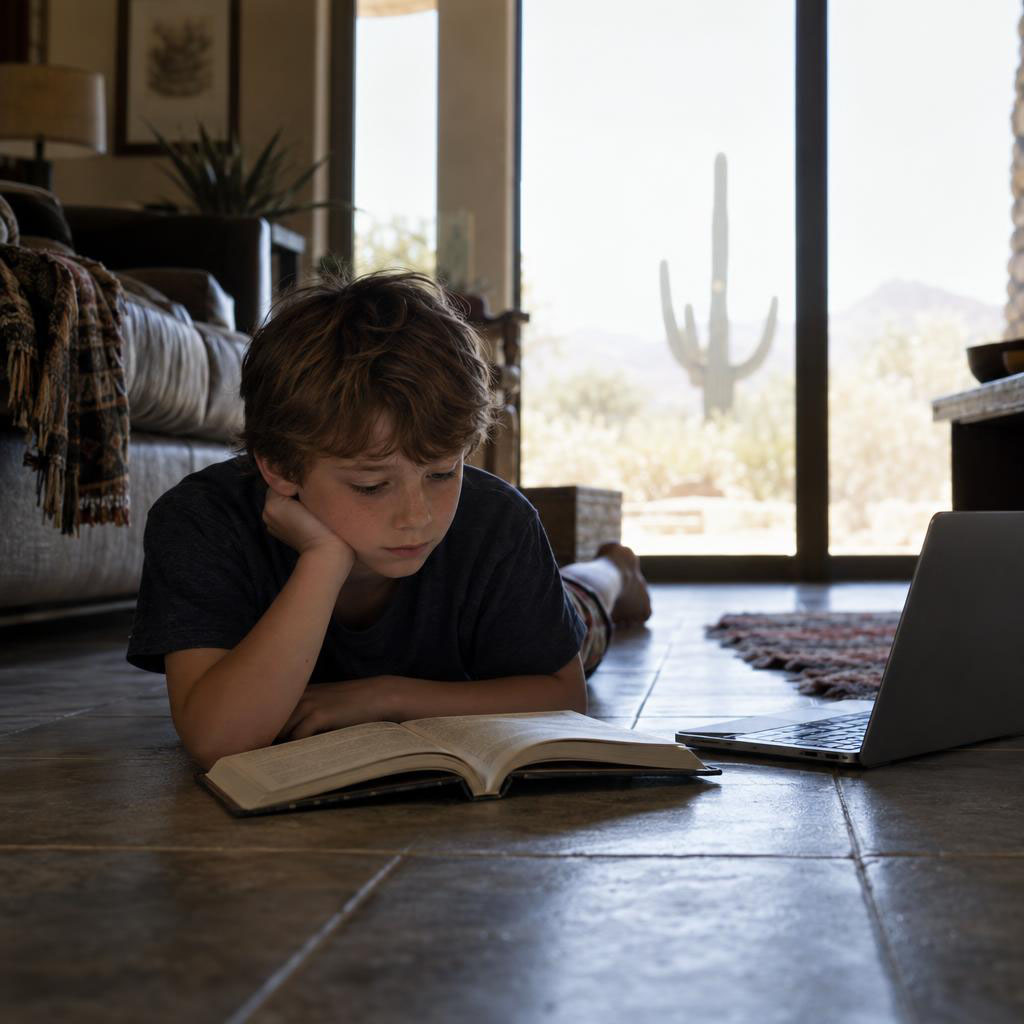
Online elementary school in Arizona: accredited options, how the universal ESA helps pay tuition, and what to look for when choosing a program for K-5.
Learn what live online classes look like for K-12 students, how formats compare, why class size matters, and where to find a truly personalized option. Explore now.

Learn how self-paced online school works, who it fits best, and what accreditation and teacher involvement really mean before you choose a program.