+1 (561) 295-3504


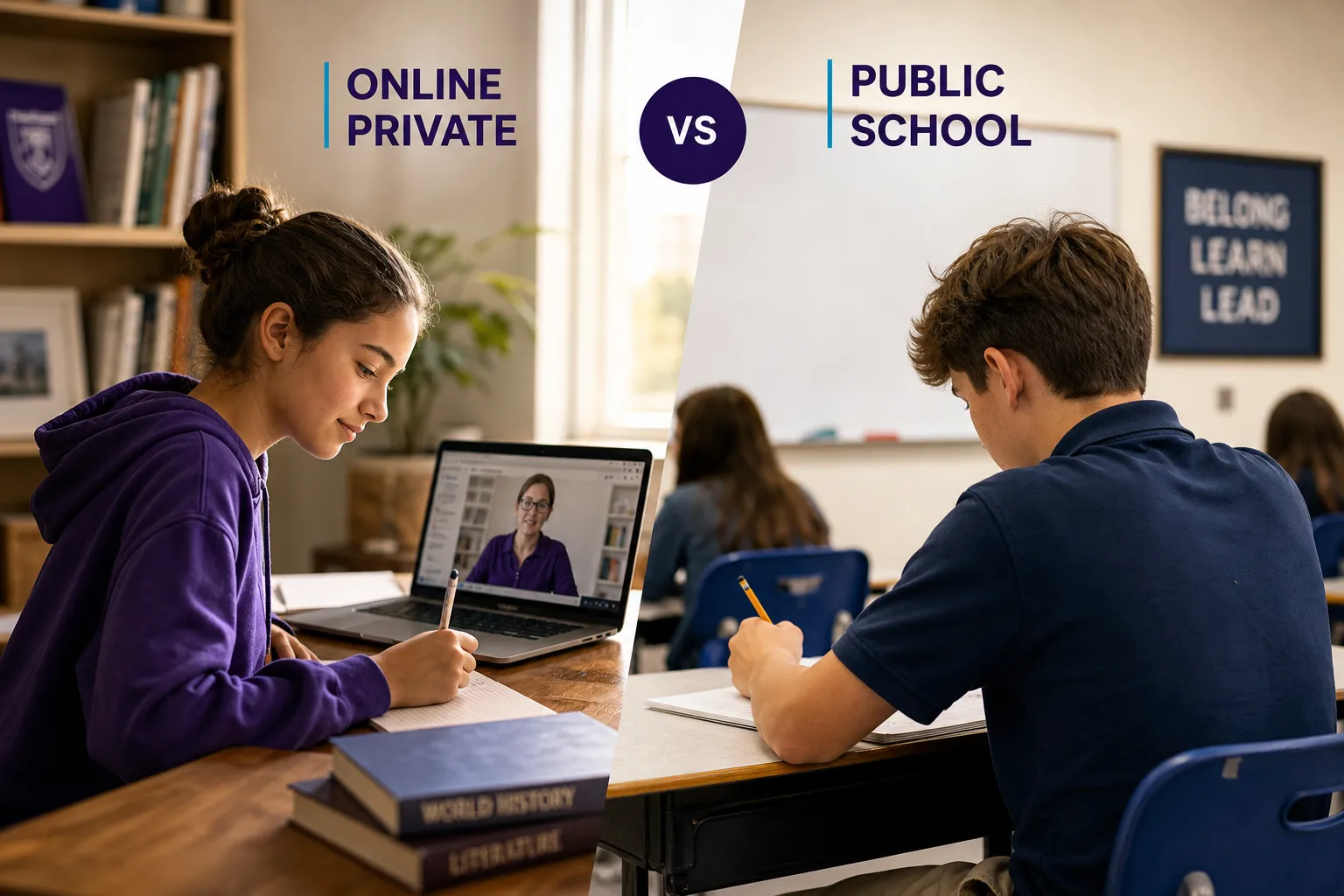
When a family starts comparing online private vs public school options, the first question is usually about cost: is the free state virtual school good enough, or is paying for a private online school actually worth it? It's a fair question, and the honest answer is that it depends entirely on what your child needs, not on which school has a better website. The difference between a state-funded virtual public school and an accredited private online school like Score Academy Online is structural, not cosmetic. This article breaks down five specific areas, cost, accreditation, teacher involvement, course depth, and college prep outcomes, so you can match the right option to your child's situation.
State-funded virtual public schools, including online charter schools and cyber schools, are tuition-free for in-state residents. They are funded by taxpayer dollars, and families may occasionally pay small fees for materials or standardized testing, but the overall cost is effectively zero. That is a genuine, significant advantage worth stating plainly.
Private online schools charge per-course or annual tuition because they receive no government funding. Costs across the industry range from roughly $1,500 to over $20,000 annually depending on the level of support the school provides, with an average that commonly falls around $14,500 per year based on industry pricing surveys. That cost gap narrows, however, for families in states with education savings account programs. Score Academy Online is an approved ESA provider in Arizona, Alabama, and New Hampshire, and the school states that it accepts Step Up For Students FES and FTC scholarships in Florida for its Synchronous package, families should confirm current approval status directly with the relevant state program. If your family qualifies for a state education savings account, the out-of-pocket cost for a private online school can drop substantially from the sticker price. Arizona's ESA allocation, for example, covers a significant portion of private school tuition for eligible families.
For families researching online homeschooling programs as an alternative, it's worth noting that accredited private online schools like Score Academy Online occupy a distinct middle ground, they provide structured, teacher-led instruction with recognized credentials, unlike most informal homeschooling arrangements.
Public online schools are accredited through state education agencies as part of the existing public school system. This happens automatically and is maintained through ongoing state oversight. The school's diploma is state-recognized by default, and credits transfer within the state system without question.
Private online schools must independently pursue accreditation from recognized bodies. Cognia (formerly AdvancED) and SACS CASI are the most recognized names in this space.
Cognia accreditation is not a rubber stamp. It requires a comprehensive self-assessment across 134 specific institutional areas, an external peer review, and stakeholder interviews, as well as a verified School Improvement Plan. The full review cycle repeats every five to six years. In practical terms, Cognia accreditation means transferable credits and a recognized diploma. Families should verify NCAA course approval directly with the NCAA Eligibility Center, as Cognia accreditation commonly supports that recognition but individual course listings still require separate NCAA approval.
Colleges evaluate transcripts based on accreditation status and course rigor, not on whether a school was public or private. A diploma from a Cognia-accredited private online school carries the same weight as a state-accredited diploma in the eyes of most admissions offices. Private online schools without recognized regional or national accreditation face real scrutiny during admissions, so verifying accreditation status is the first step any parent should take before enrolling.
Public virtual schools and online charter schools are required to employ certified teachers. That is a genuine strength of the public system. The gap between online private vs public school models is not primarily about teacher credentials, it is about how many students each teacher is responsible for at any given time.
Full-time virtual public schools have been reported to average a student-to-teacher ratio of approximately 44 students per teacher, nearly three times the national average for traditional public schools, according to analyses of virtual school enrollment data. For state-by-state comparisons, see the student-to-teacher ratios by state. At that scale, individualized feedback, proactive outreach, and genuine academic relationships are structurally difficult to deliver, regardless of how capable the teacher is. Instruction often relies heavily on asynchronous communication such as email and scheduled virtual office hours, a model that tends to favor self-directed learners but may not provide enough support for students who need more frequent, real-time guidance.
A well-structured private online school operates on a fundamentally different model. Score Academy Online states that its Synchronous package caps live class groups at six students, that certified teachers grade student work across every learning package, and that each student receives an individualized learning plan. Families considering enrollment should request current program documentation to confirm these details. That level of teacher accountability is a function of class size. When a teacher is responsible for six students rather than forty-four, the entire dynamic of the learning relationship changes.
Both state virtual public schools and accredited private online schools typically offer a range of AP courses, commonly between 15 and 25-plus options, though this varies significantly by provider and state. The difference shows up in scheduling flexibility, honors track depth, and how consistently those courses are available to every enrolled student regardless of district or state partnerships. For examples of statewide AP course availability, review a sample statewide AP course list.
Score Academy Online offers 15-plus AP courses alongside honors coursework, available through rolling enrollment rather than a semester-locked calendar. For students aiming at selective colleges, this means they can build a competitive transcript on a timeline that fits their actual academic trajectory rather than waiting for a district enrollment window to open.
College outcomes are one of the most honest indicators of what a school actually delivers. Score Academy Online reports strong college acceptance outcomes, with graduates attending selective institutions. As with any school, families should ask for documented outcomes data, including the years covered and which students were included, rather than taking marketing language at face value. A private online school that can show you verifiable graduate outcomes is demonstrating accountability in a way a brochure cannot.
State-funded virtual public schools, including cyber schools and online charter schools, require state residency. A student must live in the state where the school operates. This matters for military families mid-relocation, families in states where local virtual public options are limited, or students who need to enroll quickly outside of a traditional enrollment window. Private online schools have no residency requirement and can enroll students from any state, one reason families in underserved states or transitional situations frequently turn to them.
There is a critical legal distinction around special education services that every parent of a student with a disability needs to understand before choosing between these options. Public online schools are required by federal law, specifically IDEA and Section 504 of the Rehabilitation Act, to provide a Free Appropriate Public Education that includes IEP and 504 services. That means speech therapy, counseling, specialized instruction, and other related services must be delivered even in a virtual setting. For a federal overview, see the U.S. Department of Education's IDEA topic areas.
Private online schools are not bound by IDEA in the same way and are not legally required to provide IEP services. What support they do offer varies significantly from school to school. This is not a criticism of private online schools, it is an important distinction. If your child has an existing IEP that requires legally mandated services, the public school system carries federal protections that a private school cannot guarantee. Ask any private school directly and specifically about how they support students with learning differences before making a decision.
A state virtual public school is a legitimate, quality option for many students. If your family needs a free, accredited solution and your child is self-directed enough to work within a higher student-to-teacher ratio, the public virtual option may serve them well. If your child has an IEP requiring legally mandated services, the public school system is the one that carries the federal obligation to deliver them.
When comparing online private vs public schools, a private option like Score Academy Online is a meaningfully different fit for several specific student profiles. Consider whether any of the following applies to your child
Student-athletes who need NCAA-recognized coursework and a schedule that accommodates training and competition calendars benefit from the combination of accreditation and flexible enrollment.
Gifted learners who have exhausted the AP catalog at their local school need access to a deeper course selection with certified teachers who can provide real academic challenge.
Students who have disengaged in large classroom environments, whether from anxiety, boredom, or being lost in the crowd, often rediscover their academic footing in a small-group setting where a teacher knows their work and their goals.
Families in Arizona, Alabama, New Hampshire, or Florida who have ESA or Step Up scholarship funds available may be able to make private school tuition work financially in ways that weren't possible before those programs existed
If any of those profiles sound like your child, reviewing Score Academy Online's three learning packages, Synchronous, Flex, and Asynchronous, is a practical next step. Each is structured differently, serves a different kind of learner, and is priced per course rather than as a flat annual fee. You can reach out directly to ask an advisor which package aligns with your child's specific situation.
The core question in choosing between an online public school and an online private school is not which one sounds more prestigious. It is how much teacher involvement your child actually needs, how deep the course catalog needs to be to meet their college goals, and what your family's financial reality looks like, including whether ESA or scholarship funding is available in your state.
Accreditation is non-negotiable on either side of the online private vs public school comparison. Whether you choose a state virtual school or a private accredited school, verify that the school's credentials will be recognized by colleges and, if relevant, by the NCAA. A diploma that doesn't transfer is not worth the time your child invested in earning it.
For families who want to explore what the private option looks like in concrete terms, Score Academy Online is a straightforward place to start. The school holds Cognia and SACS CASI accreditation and employs certified teachers across every learning package. Visit Score Academy Online to review the packages, read verified parent reviews, and connect with an advisor who can walk you through which option aligns with your child's goals. For an independent overview of how much online high school costs, this guide provides helpful context when weighing public versus private tuition.

How many credits to graduate high school? Most states require 20 to 24 credits across English, math, science, and social studies. See the state-by-state guide.

Online elementary school in Arizona: accredited options, how the universal ESA helps pay tuition, and what to look for when choosing a program for K-5.

An online elementary school curriculum covers reading, math, science, and social studies across grades K-5. Here's what students learn and how it's taught.