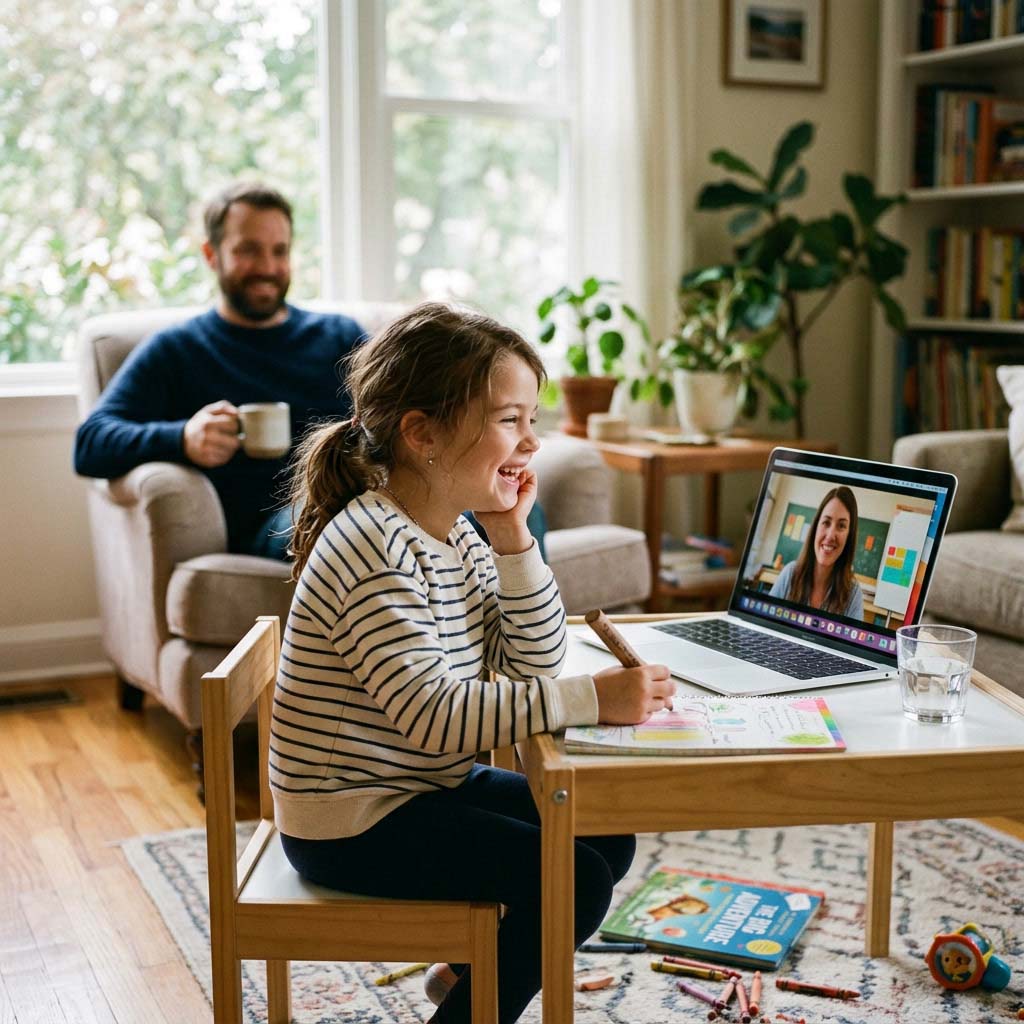
Online school for 2nd grade gives a seven or eight year old a full second-grade education at home, taught by certified teachers through live video lessons, with a parent or caregiver acting as a learning coach for the parts of the day that call for a nearby adult. A strong program covers reading, writing, math, science, and social studies on a set daily schedule, keeps lessons short and interactive to match young attention spans, and builds the reading and number skills that the rest of elementary school depends on. Second grade is a foundation year, so the goal is steady mastery rather than speed.
Here is what second graders learn, how a school day works online, and how to tell whether it fits your child.
Second grade consolidates the skills children started in kindergarten and first grade. In reading, students move from sounding out words toward reading smoothly and with understanding, and they begin reading longer passages to answer questions about them. In writing, they compose complete sentences and short paragraphs, learning capitalization, punctuation, and spelling patterns along the way.
Math takes a big step. Second graders work with place value into the hundreds and thousands, add and subtract two and three digit numbers with regrouping, tell time to the nearest five minutes, count money, measure length, and meet the early ideas behind multiplication. Science and social studies introduce topics like habitats, weather, communities, and maps, often through hands-on activities. Across every subject, the through line is building fluency: doing the basics accurately and automatically so harder work later has a solid base.
A typical online second grade runs on a daily schedule with live, teacher-led lessons in small groups, broken into short blocks so a young child stays focused. A morning might hold a reading lesson, a math lesson, and a special like art or science, with movement breaks in between. Because seven year olds still need a nearby adult, a parent or learning coach helps the child log in, keeps them on track during independent practice, and reads instructions when needed. The time commitment is lighter than many parents expect, often a few hours of focused instruction rather than a full six-hour day.
The best online second grade programs pair that structure with real interaction. Teachers call on students by name, check understanding in the moment, and give quick feedback, and small classes make that possible. Screen time is balanced with offline work: printed worksheets, hands-on math manipulatives, reading real books, and drawing. A good program treats the screen as the place where teaching happens, not the place where a child is parked for hours.
Online second grade is not the right answer for every family, and the honest way to decide is to look at the child and the household together. It tends to fit well when a parent, grandparent, or caregiver can be present as a learning coach during the school day, since seven and eight year olds still need help staying on task. It also suits children who focus better in a quiet space than in a room of twenty-five, families who travel or move often, and students who are either ahead and bored or behind and in need of individual attention that a large class cannot give.
It is a weaker fit when no adult is available during the day, or when a child depends heavily on constant peer contact to stay engaged and the family cannot add social activities outside school. The good news is that most concerns, especially about socializing, are manageable with small live classes and outside activities, so the real question is usually whether the daily support is there.
Reading is the skill that second grade lives or dies on, and accuracy matters as much as speed. A study by Abbott and colleagues (2012), which examined 920 second graders and 974 third graders, found that low oral reading fluency and high error rates predicted weaker passage comprehension, and identified grade-specific error thresholds where comprehension started to suffer. The practical takeaway for a family choosing an online second grade is to favor a program where a teacher listens to your child read aloud regularly, catches errors early, and adjusts, because a child who reads accurately and smoothly can turn attention to understanding the text. A program that only assigns silent reading with no one listening misses exactly the checkpoint this research highlights.
Score Academy Online is a Cognia-accredited, NCAA-approved online private school serving grades K-12, with live certified teachers, an individualized education plan for every student, and small synchronous classes capped at four students in the elementary grades. That small cap is a natural fit for second grade, where a teacher needs to hear each child read and watch each child work. Families can see how the K-12 curriculum is organized and review the school's Cognia and NCAA accreditation before enrolling.
The school offers three ways to learn, so families can match the format to the child: a self-paced option, a Flex option, and a live Synchronous option with the smallest classes. Per-course tuition runs from $415 for self-paced elementary courses to $2,125 for live elementary courses, and rolling enrollment lets a second grader start any time of year rather than waiting for a September start. You can explore how the online elementary school is built for younger learners, and the college outcomes page shows where the school's approach leads by graduation, including a 100% college acceptance rate.
Is online school a good idea for a second grader? It can be, for the right child and family. Online second grade works well when a parent or caregiver is available to act as a learning coach, and when the program uses live teachers and short, interactive lessons rather than long stretches of screen time. It suits families who travel, who want smaller classes, or whose child needs a calmer setting than a busy classroom.
How many hours a day is online second grade? Less than a full school day. Focused instruction for a second grader usually runs a few hours, since young children learn in shorter blocks. The rest of a typical day is hands-on practice, reading, and breaks, which parents can arrange around their schedule in more flexible programs.
What does a second grader need to do online school? Not much beyond a reliable device, an internet connection, and a quiet spot to work. A nearby adult to help with logging in and staying on task matters more than any gadget, especially early in the year while routines are forming.
What do second graders learn in an online program? The same core subjects as a classroom: reading and writing, math through place value and two and three digit addition and subtraction, plus science and social studies. A quality program follows grade-level standards so a child can move between schools without gaps.
Will my child fall behind socially? A good program builds in interaction through small live classes, group activities, and discussion, and many families add sports, clubs, or playdates outside school. Second graders in a small online class often speak up more than they would in a room of twenty-five.
Can my child start second grade online mid-year? Yes, at schools with rolling enrollment. A child can transfer in during the fall, winter, or spring, and teachers assess where the student is so instruction picks up at the right level rather than starting over.

How many credits to graduate high school in NC? North Carolina requires 22 credits under Future-Ready Core. See the full course-by-course breakdown here.
How many credits to graduate high school in Texas? Students need 22 under the Foundation program, or 26 for Distinguished. See the full credit breakdown here.

How many credits to graduate high school? Most states require 20 to 24 credits across English, math, science, and social studies. See the state-by-state guide.