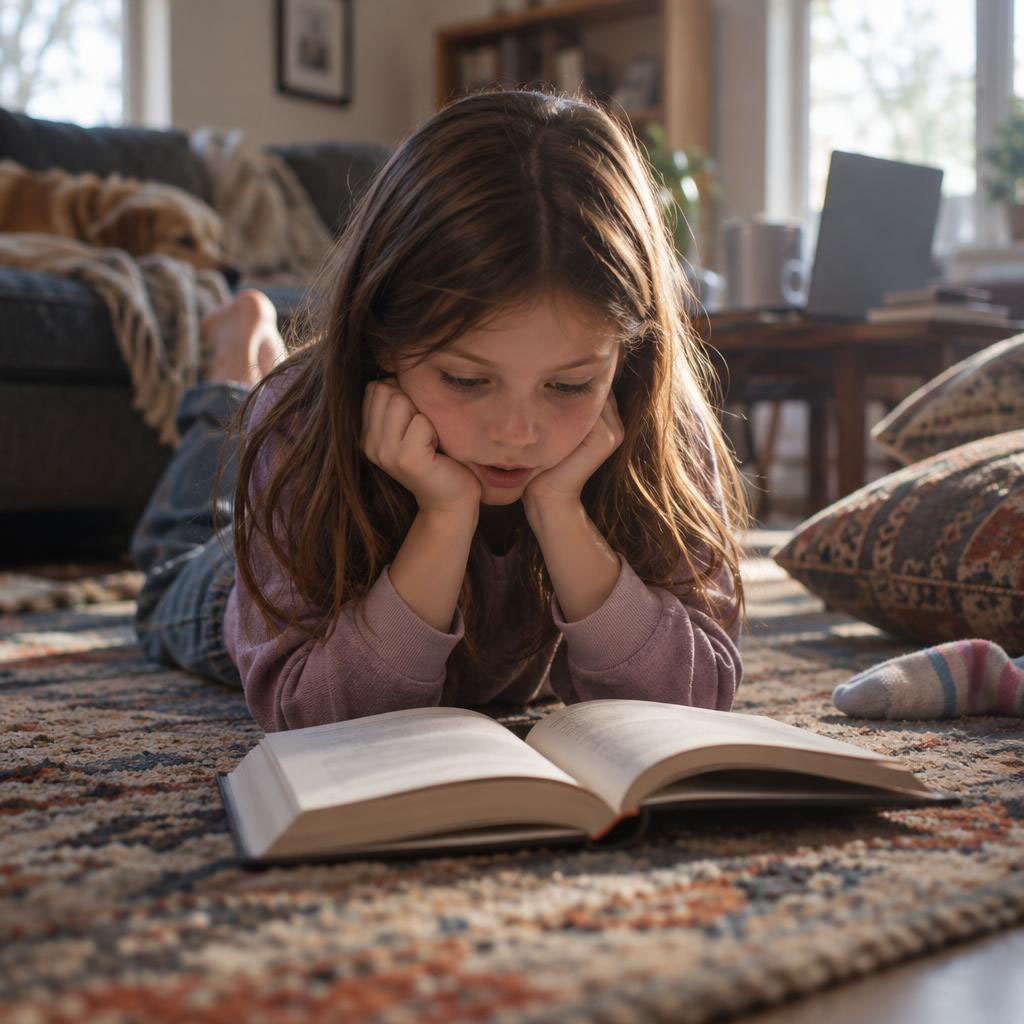
Online school for 3rd grade delivers a full third-grade education at home through live lessons with certified teachers, covering reading, writing, math, science, and social studies on a structured daily schedule. Third grade is a turning point: students shift from learning to read toward reading to learn, meaning they now use reading to absorb new material in every subject. A strong online program supports that shift with real instruction and feedback, introduces multiplication, division, and fractions in math, and keeps children engaged enough to build the reading habit that carries them through upper elementary.
Here is what third graders learn, how online school works at this age, and why keeping a child motivated to read matters more than parents sometimes realize.
Third grade is widely treated as a milestone year, and for good reason. Reading stops being the subject and becomes the tool: students read to learn science, social studies, and math, so a child who is still struggling to decode words faces a growing gap. In reading itself, third graders tackle longer texts, summarize them, identify main ideas, and read both stories and informational writing. Writing grows into structured paragraphs and short reports with a beginning, middle, and end.
Math expands quickly. Third graders learn multiplication and division, work with fractions for the first time, handle multi-digit addition and subtraction, tell time to the minute, and solve multi-step word problems. Science and social studies deepen, often with the child reading and researching rather than only listening. Many states also give their first major standardized tests in third grade, which makes solid reading and math foundations especially important this year.
An online third grade runs on a daily schedule of live, teacher-led lessons, usually in small groups, with subjects broken into focused blocks and breaks between them. Third graders are more independent than younger children, so they can handle somewhat longer lessons and more solo practice, though a parent or learning coach still helps with structure and stays available for questions. Compared to a classroom, an online day is often shorter and more concentrated, with less time lost to transitions and crowd management.
Interaction is what separates a strong program from a weak one. Live teachers can ask a child to explain their thinking, catch a misunderstanding in fractions before it hardens, and give feedback while it still matters. Small classes make that individual attention realistic. Good programs also balance screen time with offline reading and hands-on math, and they track progress so parents can see how their child is doing against grade-level goals rather than guessing.
Online third grade fits some children better than others, and the decision comes down to the child and the family. It works well for students who are ready for a bit more independence, who concentrate better in a calm setting than in a crowded classroom, and who benefit from the close attention a small live class provides, whether they are racing ahead or need extra help with reading or math. It also suits families who travel, who have moved, or who want more say in their child's daily learning.
It is a harder fit when no adult can be nearby to help with structure during the day, or when a child leans heavily on constant in-person contact with classmates and the family cannot add clubs, sports, or other social time. For most families, though, small online classes and outside activities cover the social side, so the deciding factor is usually whether someone can support the routine at home.
As reading becomes harder and more demanding in third grade, whether a child wants to read starts to shape how well they read. A review by Wigfield and colleagues (2016) synthesized research on children's reading motivation and found that motivation and engagement are positively associated with reading comprehension, and that programs designed to increase interest and engagement in reading improved both. The lesson for families choosing an online third grade is to look for teachers who make reading feel worthwhile, connect texts to a child's interests, and give students some choice in what they read, because a motivated third grader reads more, and a child who reads more improves. A program that treats reading as a joyless daily worksheet works against the very skill third grade is built to develop.
Score Academy Online is a Cognia-accredited, NCAA-approved online private school serving grades K-12, with live certified teachers, an individualized education plan for every student, and synchronous elementary classes capped at four students. Small classes let a teacher notice when a third grader is quietly falling behind in reading or math and respond early, and the individualized plan means instruction meets each child where they are. Families can review how the K-12 curriculum is structured and check the school's Cognia and NCAA accreditation before enrolling.
Three learning formats let families choose the right fit: a self-paced option, a Flex option, and a live Synchronous option with the smallest classes. Per-course tuition runs from $415 for self-paced elementary courses to $2,125 for live elementary courses, and rolling enrollment means a third grader can join in the fall, winter, or spring. Parents can see how the online elementary school supports younger students, and the college outcomes page shows the long-term results of the school's approach, including a 100% college acceptance rate and $14.2 million in scholarships earned by graduates.
Is third grade a good time to switch to online school? It can be a helpful time, because third grade brings more independent work and a shift toward reading to learn, which a small online class with live teachers can support closely. The key is a program that gives real instruction and feedback rather than leaving a child alone with videos.
What do third graders learn? Core subjects deepen: reading longer stories and informational texts, writing structured paragraphs, and math that adds multiplication, division, and fractions to multi-digit addition and subtraction. Science and social studies increasingly ask students to read and research on their own.
How long is an online third grade day? Usually shorter than a classroom day. Focused, live instruction often runs a few hours, with the rest of the day spent on reading, practice, and breaks. More flexible programs let families arrange that time around their own schedule.
Why is third grade considered so important for reading? Because students shift from learning to read to reading to learn. After third grade, reading is how children absorb new material in every subject, so a child who reads well has an advantage, while a child who struggles can fall further behind without support.
Will my child be ready for state testing online? A quality online program follows grade-level standards and often practices the skills state tests assess, so students are prepared. Teachers can also spot and shore up weak areas before testing season through regular progress checks.
Can a third grader do online school without a parent nearby all day? More than a younger child, but not entirely alone. Third graders handle longer stretches of independent work, yet they still benefit from an adult who can help with structure and answer questions, especially early in the year.

How many credits to graduate high school in NC? North Carolina requires 22 credits under Future-Ready Core. See the full course-by-course breakdown here.
How many credits to graduate high school in Texas? Students need 22 under the Foundation program, or 26 for Distinguished. See the full credit breakdown here.

How many credits to graduate high school? Most states require 20 to 24 credits across English, math, science, and social studies. See the state-by-state guide.