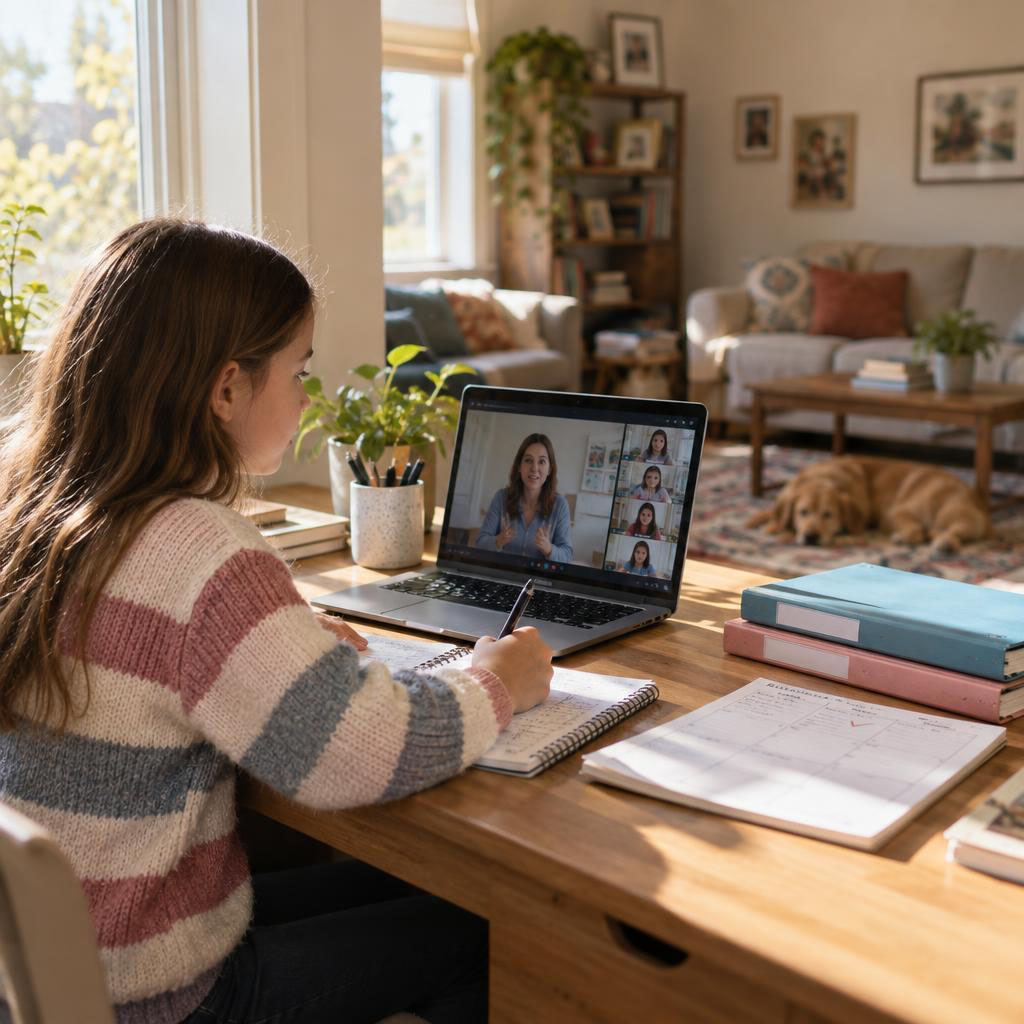
Online school for 5th grade gives a ten or eleven year old a full fifth-grade education at home through live lessons with certified teachers, covering reading, writing, math, science, and social studies. Fifth grade is the last year of elementary school, so alongside the academics it is about building the independence, organization, and study habits a child will need when middle school arrives with more teachers, more subjects, and higher expectations. A strong online program teaches the fifth-grade curriculum well and deliberately prepares students for that jump.
Here is what fifth graders learn, how online school works at this age, and how to get a child ready for the move to middle school.
Fifth grade pulls together the elementary years and stretches toward what comes next. In reading, students analyze longer and more complex texts, compare sources, and support ideas with evidence. Writing becomes multi-paragraph essays and research pieces with clear structure and revision. The workload grows, and so does the expectation that students manage their own time and materials.
Math is demanding. Fifth graders add, subtract, multiply, and divide fractions and decimals, meet ratios and the early ideas behind percentages, work with volume and the coordinate plane, and solve multi-step problems that combine skills. Science moves into more formal investigation, and social studies often covers history and geography in depth. This is the year students take on longer projects and juggle several subjects at once, which is exactly the kind of independence middle school will demand.
An online fifth grade runs on a daily schedule of live, teacher-led lessons, usually in small groups, with subject blocks and breaks. Fifth graders are capable of substantial independent work, so a parent or learning coach steps back into a supervisory role, helping with organization and checking in rather than sitting alongside. A focused online schedule often accomplishes in a few concentrated hours what a classroom spreads across a longer day.
Interaction still drives learning. Live teachers can ask a fifth grader to defend an argument, work through a multi-step math problem on screen, and give timely feedback on writing, and small classes make that individual attention realistic. Good programs balance screen time with offline reading, writing, and hands-on science, and they report progress against grade-level standards. Just as important at this age, a strong program starts handing students more responsibility for tracking assignments and managing their time, a rehearsal for middle school.
Online fifth grade works for many students on the cusp of middle school, but it is not right for everyone, and the honest question is whether the child and the household match. It fits well for students ready to take more ownership of their work with light supervision, who focus better in a calm setting than in a crowded room, and who gain from the close attention of a small live class, whether they need more challenge or more support. Families who move, travel, or want a bigger role in their child's education also tend to find it a good fit.
It is a harder fit when no adult is available to help with organization during the day, since even capable fifth graders benefit from some structure, or when a child depends on constant in-person contact with classmates and the family cannot add outside social time. For most families, small classes plus clubs or sports cover that, so the real question is the support at home. Either way, the choice is worth weighing carefully, because fifth grade sets the tone for the more independent middle school years just ahead.
The move from elementary to middle school is one of the harder transitions in a student's life, and preparation makes a difference. A review by Evans and colleagues (2018) examined the academic and psychological effects of the transition to secondary school and found that many students experience a dip in grades, motivation, and confidence as they move to a larger, more demanding setting, with supportive relationships and preparation acting as buffers. The takeaway for a fifth-grade family is to choose a program that builds independence and study skills now and keeps teachers closely connected to each student, because a child who enters middle school organized, confident, and used to managing their own work is far better positioned. A small online class that knows a student well offers exactly the kind of support the research points to.
Score Academy Online is a Cognia-accredited, NCAA-approved online private school serving grades K-12, with live certified teachers, an individualized education plan for every student, and synchronous elementary classes capped at four students. Because the school runs through high school, a fifth grader can move into its online middle school without changing schools, so the transition happens inside a familiar program with teachers who already know the student. Families can review how the K-12 curriculum is organized and check the school's Cognia and NCAA accreditation before enrolling.
The online elementary school covers kindergarten through fifth grade, and three learning formats let families choose the right structure: a self-paced option, a Flex option, and a live Synchronous option with the smallest classes. Per-course tuition runs from $415 for self-paced elementary courses to $2,125 for live elementary courses, and rolling enrollment means a fifth grader can start in the fall, winter, or spring. The college outcomes page shows where the school's approach leads, including a 100% college acceptance rate and $14.2 million in scholarships earned by graduates.
Is online school a good choice for fifth grade? It can be, especially for a child ready for more independent work and for families who want a small, focused setting before middle school. Fifth grade's heavier workload is well supported by live teachers in small online classes, as long as the program teaches actively rather than assigning videos.
What do fifth graders learn? Reading and writing grow more analytical, with essays and evidence-based work, while math covers operations with fractions and decimals, ratios, early percentages, volume, and the coordinate plane. Science and social studies deepen through investigation and longer projects.
How do I prepare my fifth grader for middle school? Build independence and study habits now: let the student track assignments, manage time, and take more ownership of their work, and keep them in a setting where teachers know them well. Staying in a K-12 program can also smooth the move by keeping teachers and structure consistent.
How much parent involvement does online fifth grade require? Less than the earlier grades. Fifth graders handle long stretches of independent work, so a parent or learning coach mainly supervises, helps with organization, and stays available for questions.
How long is an online fifth grade day? Typically shorter than a classroom day. Focused live instruction often runs a few hours, with the rest of the day for reading, projects, and practice, and flexible programs let families arrange that time to fit their schedule.
Can my fifth grader start online school mid-year? Yes, where rolling enrollment is available. Teachers assess the student's level so instruction continues at the right point, which helps a mid-year transition go smoothly right before the middle school years.

How many credits to graduate high school in NC? North Carolina requires 22 credits under Future-Ready Core. See the full course-by-course breakdown here.
How many credits to graduate high school in Texas? Students need 22 under the Foundation program, or 26 for Distinguished. See the full credit breakdown here.

How many credits to graduate high school? Most states require 20 to 24 credits across English, math, science, and social studies. See the state-by-state guide.