+1 (561) 295-3504



Bullying does far more than cause emotional pain. Research consistently shows that students who experience bullying demonstrate measurable declines in academic performance, attendance, and engagement.
A comprehensive meta-analysis published in World Journal of Psychiatry examined 165 studies on the consequences of bullying victimization. The researchers found that students who experienced bullying were significantly more likely to report poor academic achievement (OR = 1.33) and that good academic achievement was less likely among bullied students (OR = 0.71). The study also found "convincing evidence" for causal relationships between bullying victimization and anxiety, depression, and poor general health (Moore et al., 2017).
These findings underscore why simply telling students to "ignore" bullying fails. The psychological toll creates real cognitive barriers to learning that persist until the source of stress is removed.
Many schools have implemented anti-bullying programs, yet the problem persists for millions of students. Even when administrators take reports seriously, the social dynamics that enabled bullying rarely disappear overnight. A student might find themselves in classes with their former bullies, eating lunch in the same cafeteria, or walking the same hallways where incidents occurred.
For some students, the environment itself becomes the trigger. Even after specific bullying behaviors stop, the associations remain. School transfers can help, but they require students to leave behind supportive friends while navigating an unfamiliar social landscape and adjusting to new academic expectations simultaneously.
Online education removes the environmental triggers entirely. Students learn from home, eliminating daily exposure to spaces associated with negative experiences. This physical separation provides immediate psychological relief and creates room for healing.
Consider a student like Mia, a hypothetical tenth grader who experienced severe social exclusion at her previous school. In an online setting, she begins on equal footing with classmates who have no preconceptions about her. Interactions occur through structured academic activities rather than unstructured social situations where bullying typically flourishes.
The asynchronous nature of some online coursework also provides processing time. Students can craft responses to discussion posts thoughtfully rather than facing the pressure of immediate verbal interaction.
The structure of online education inherently differs from large traditional classrooms in ways that benefit bullied students. Score Academy maintains a maximum of six students per live class session, creating an environment where teachers know each student individually and can monitor interactions closely.
In small group settings, the social hierarchy dynamics that enable bullying struggle to take hold. There is no "back of the classroom" where a student can be quietly tormented while the teacher focuses elsewhere. Every student is visible, every voice is heard, and inappropriate behavior is immediately apparent.
Many bullied students arrive at online school with damaged academic self-concepts. Months or years of distraction, avoidance, and stress-impaired learning have created gaps in knowledge and skills. They may believe they are "bad at school" when they are actually dealing with the aftermath of trauma.
Effective online programs address this reality through individualized attention. Teachers at Score Academy work with students to identify knowledge gaps and create plans for filling them. The smaller class sizes mean that students who need additional explanation receive it without embarrassment. Flexible pacing allows students to build mastery at a sustainable pace, with each success building confidence for the next challenge.
Not all online schools provide the supportive environment that bullied students need. Some rely heavily on self-paced modules with minimal teacher interaction, leaving students isolated in a different way. Others pack so many students into live sessions that individual attention becomes impossible.
When evaluating online schools for a bullied student, families should ask specific questions. What is the maximum class size for live sessions? How do teachers handle interpersonal conflicts? What training do instructors have in supporting students with anxiety or trauma histories? Are all teachers certified in the subjects they teach?
Score Academy's commitment to certified teachers and small class sizes reflects an understanding that vulnerable students need more support, not less.
One concern parents often express about online school involves social development. For bullied students, the relevant question is actually different: What kind of social experiences support healthy development? Repeated exposure to rejection and exclusion does not build social skills. It teaches students that relationships are dangerous.
Online school provides structured social interaction in academic contexts, where teachers facilitate discussions and group projects. Students connect with peers who share academic interests rather than being sorted by geography. The quality of interaction matters more than the quantity, and positive interactions in safe settings help students rebuild trust in peer relationships.
Families should consider online education for a bullied student when traditional interventions have proven insufficient. If a student experiences persistent anxiety about school, if academic performance has declined significantly, if they are avoiding school through illness claims or refusal, these signs suggest that the environment itself has become the problem.
Online school is not about running away from challenges. It is about removing a student from an actively harmful situation so that genuine learning and healing can occur.
The transition from a bullying situation to online school should be framed as a positive choice rather than a failure. Students are not being pulled from school; they are moving to a better learning environment.
At Score Academy, we understand that bullied students arrive with more than academic needs. They need patient teachers, small supportive classes, and an environment where their past experiences do not follow them.
Frequently Asked Questions
How quickly do bullied students typically adjust to online school? Most students experience immediate relief from anxiety once they no longer face daily exposure to threatening environments. Academic confidence typically rebuilds over several months as students experience success in a supportive setting.
Will my child still develop social skills in online school? Yes. Online school provides structured social interaction through live classes and collaborative projects. These positive peer experiences actually support healthier social development than continued exposure to bullying.
What if my child was bullied online as well as in person? Online school environments are monitored differently than social media platforms. Teachers supervise interactions, class sizes are small, and behavioral expectations are clear. The controlled academic setting differs significantly from unmonitored online spaces.
How do online schools handle conflict between students? At Score Academy, small class sizes allow teachers to address conflicts immediately. Clear behavioral expectations and direct adult supervision prevent most issues, and any problems are resolved through direct intervention.
Can my child return to traditional school later? Absolutely. Many students use online school as a period of healing and academic rebuilding before transitioning back to in-person education when they feel ready. Others discover that online learning suits them well and continue through graduation.
What support does Score Academy offer for students with anxiety? Our small class sizes, individual attention from certified teachers, and supportive environment help anxious students thrive. Teachers build relationships with students and provide the encouragement and patience that healing requires.
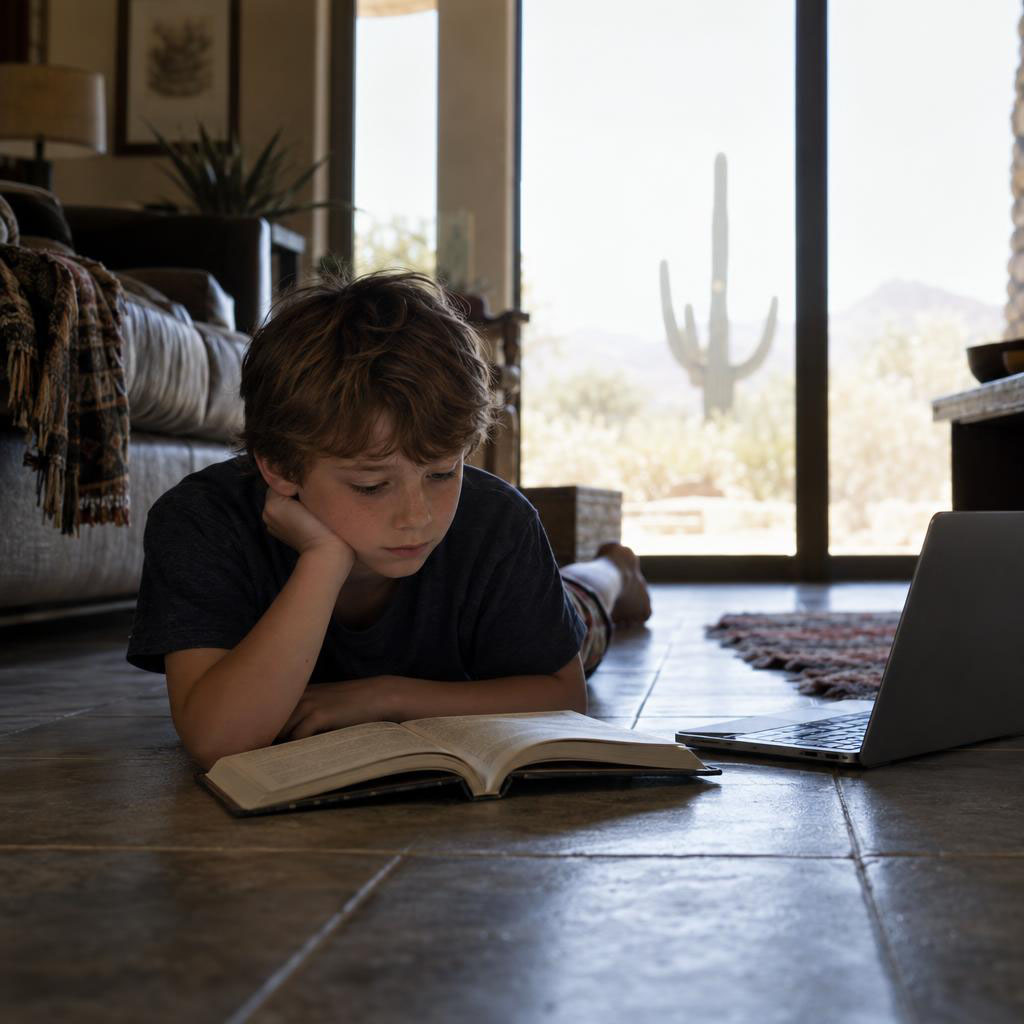
Online elementary school in Arizona: accredited options, how the universal ESA helps pay tuition, and what to look for when choosing a program for K-5.

An online elementary school curriculum covers reading, math, science, and social studies across grades K-5. Here's what students learn and how it's taught.
Learn what live online classes look like for K-12 students, how formats compare, why class size matters, and where to find a truly personalized option. Explore now.