+1 (561) 295-3504


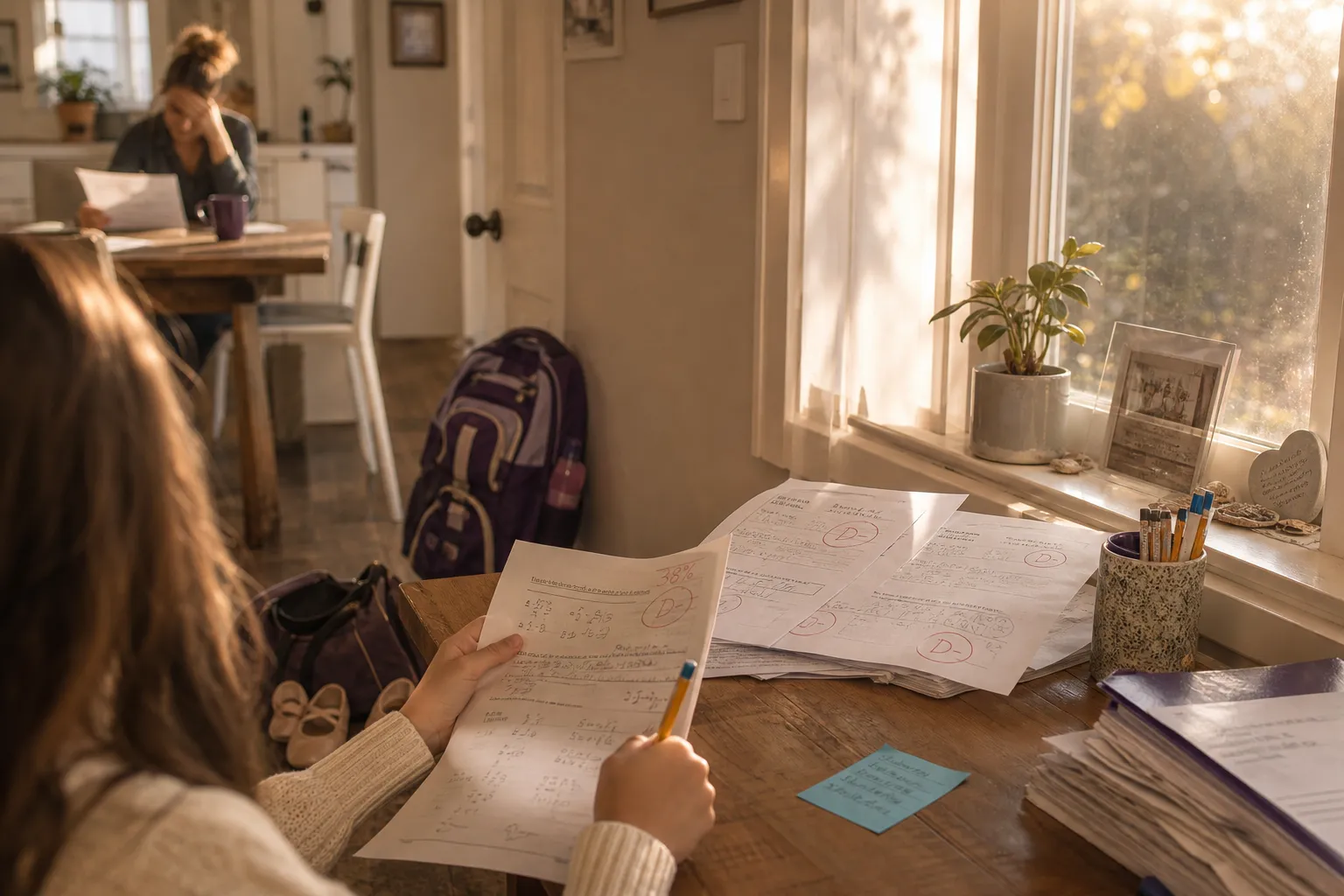
If your child is struggling in traditional school, you may notice the signs before they can put words to what they're feeling. Picture this: your child used to race to the bus on Monday mornings. Now they're sitting at the kitchen table on Sunday night, shoulders tight, already dreading tomorrow. The stomachaches that started in September are gone by Saturday afternoon. When you ask how school went, you get a shrug. Something has shifted, and you feel it even if you can't name it yet.
That feeling is worth trusting. Children rarely have the vocabulary to say "I'm overwhelmed" or "I don't understand what's happening in class." What they have instead is behavior, and behavior is always communicating something. This article helps you decode what you're seeing, understand what's most likely driving it, and take a clear sequence of steps to get real help.
Some families who go through this process find that a few targeted adjustments at home and school are enough to turn things around. Others discover that the traditional classroom structure itself is a poor fit for their child. Either way, the options available in 2026 are broader than most parents realize, and knowing what to look for is the place to start.
Every child has a rough week. The benchmark that should put you on alert is a pattern that is new, persistent, and out of character for your specific child. A kid who has always been resistant about homework is different from a kid who used to sit down and work and now refuses entirely. Context matters. So does trajectory.
Declining test scores, incomplete assignments, and a sharp drop in effort that doesn't match your child's ability are among the clearest academic signals. Pay particular attention to inconsistency: a child who seems to know the material but tests poorly, or who does reasonably well one week and falls apart the next, is showing you something. Difficulty following multi-step instructions and persistent trouble with foundational skills like reading, spelling, or writing are also red flags. These are not signs of laziness; they are signs that something in the learning process is breaking down.
Irritability after school, outbursts that seem disproportionate, pulling away from friends, and a reluctance to ask for help in class are all behavioral signals worth tracking. A child who was once enthusiastic about a subject and now claims to hate it is telling you something specific. Behavioral changes at school almost always spill into home behavior. When your child is oppositional at pickup, difficult through dinner, and hard to reach all evening, it usually means something happened during the school day that they don't yet have the tools to process.
Stomachaches and headaches that cluster on Sunday nights and school mornings, then disappear by Saturday, are a child's body communicating what words haven't caught up to. Sleep disruption and appetite changes belong in this category too. These complaints are real, not manipulative, and they warrant a closer look at the school environment rather than a reflexive trip to the pediatrician. When physical symptoms follow a weekly schedule, the schedule is pointing you toward the cause.
The signs above don't have a single source. Understanding what's actually driving the struggle is what determines which kind of help will work. Four profiles account for the large majority of children who fall behind or disengage in traditional classroom settings.
Dyslexia, ADHD, and executive function deficits show up in traditional classrooms in predictable ways: lost homework, inability to sustain focus through long lessons, trouble organizing a backpack or a multi-step project, and output that is wildly inconsistent from one day to the next. One thing many parents don't know is that a gifted child can mask a learning disability for years because raw intelligence compensates for the weakness. These students are often read as lazy, distracted, or unmotivated rather than as kids who are working twice as hard as their classmates just to stay even. If your child is bright but underperforming, a learning difference is worth ruling out.
School anxiety and school refusal are clinical patterns, not defiance. According to the American Academy of Pediatrics, between 2% and 5% of school-age children experience school refusal, with separation anxiety, social anxiety, and fear of evaluation among the most commonly documented triggers. Anxiety can look like avoidance, excessive reassurance-seeking, social withdrawal, or physical illness, and it is frequently missed at school because the child may be compliant in class while falling apart at home. If your child holds it together all day and then dissolves the moment they walk through your door, that contrast is data.
A child whose abilities are above grade level but who receives no differentiation or challenge will often disengage in ways that look almost identical to a learning problem. Boredom in this population is not a minor inconvenience; it produces school disengagement that is real and measurable. The twice-exceptional profile, where giftedness and a learning difference coexist, is especially difficult to identify because the two conditions can mask each other. According to a 2022 review published in Gifted Child Quarterly, roughly 14% of intellectually gifted children may have a co-occurring learning disability, compared to about 4% in the general population. That overlap is too common to ignore.
You don't need to wait for a teacher meeting or a formal assessment to start helping. These first steps are within your control today, and taking them now gives you better information before you ever walk into a school meeting.
Predictable home routines reduce anxiety significantly for children who are already overwhelmed. A consistent bedtime, a fixed homework window, and a reliable morning prep sequence give a child who is struggling in a traditional school something stable to hold onto when the school day feels unpredictable. For academic catch-up, short and frequent practice with immediate feedback outperforms marathon cramming sessions. Twenty minutes of reading support at the same time every evening builds more than a two-hour Sunday session the night before a test.
The conversation matters as much as the structure. Asking "what's the hardest part of your day?" gets far more honest information than "why are your grades dropping?" Lead with curiosity, not concern, and resist the urge to fix before you've finished listening. Your goal in the first conversation is to identify the specific trigger, whether it's a particular subject, a social situation, or a single class period, before you decide on a response. Children who feel heard are significantly more willing to accept support.
Once you have a clearer picture of what's happening, the school-side process becomes your next priority. Understanding how it works saves time and reduces frustration.
Before you schedule a meeting, write things down. Dates, specific incidents, examples of work, and direct quotes from your child give a teacher or counselor something concrete to respond to. Request the meeting in writing, briefly summarize your concerns, and frame the conversation as collaborative problem-solving rather than a complaint. A teacher who receives a specific, documented concern responds differently than one who hears general frustration. That distinction can determine whether you leave the meeting with a plan or a polite brush-off.
Under federal IDEA rules, a parent can request a formal educational evaluation in writing at any time. Once the school receives written parental consent, they have 60 days to complete the evaluation, though some states have shorter timelines. The outcome of that evaluation determines whether your child qualifies for an IEP, which provides special education services, or a 504 plan, which provides accommodations without a special education designation. If you suspect a learning difference, giftedness, ADHD, or anxiety, this evaluation is the most important step you can take inside the traditional school system. It gives you a documented baseline and, if eligibility is established, legal protections for your child's education.
Here's something most schools won't say directly: sometimes the mismatch is not the child's disability or the family's home environment. Sometimes the traditional classroom model, with its large class sizes, rigid pacing, and limited teacher bandwidth, genuinely cannot meet a particular child's needs. That is not a failure on your part or your child's part. It is a structural limitation worth naming clearly.
The alternative settings that consistently produce the best outcomes for struggling, anxious, or twice-exceptional learners share a specific set of characteristics: small class sizes, individualized instruction, flexible pacing, and a consistent relationship with a trusted adult. These are not nice-to-haves. The most consistent predictor of re-engagement across research on school disengagement is a relationship-based, individualized environment, the factor that moves outcomes more reliably than any single curriculum or technology. Generic platforms that rely on software-driven learning without consistent teacher involvement do not replicate this effect.
Score Academy Online is a specific example of what this kind of environment looks like in practice. It holds Cognia and SACS CASI accreditation, which means credits transfer and colleges recognize the diploma. The Synchronous package offers live classes in groups capped at six students, a ratio that makes it structurally impossible for a child to disappear into the background. Certified teachers grade all work across every package, including the self-paced Asynchronous and the recorded Flex options, so a real educator is always tracking your child's progress. Score Academy Online also holds NCAA-approved coursework and serves as an approved ESA provider in Arizona, Alabama, West Virginia, and New Hampshire, with Step Up FES and FTC scholarships accepted in Florida for the Synchronous package.
Online private school is not the right fit for every child, and it would be dishonest to suggest otherwise. But for a child who has been falling through the cracks in a traditional school, the combination of small class sizes, real teacher accountability, and flexible scheduling can change the trajectory in ways that a standard IEP or 504 plan in a large classroom often cannot.
Go back to the parent at the beginning of this article. The child dreading Monday, the Sunday night stomachaches, the silence in the car after pickup. Recognizing those signs as signals that your child is struggling in traditional school, and asking what to do about them, is exactly the right move. Acting on them early is what separates a temporary rough patch from a years-long pattern of struggle.
The sequence is straightforward: identify the pattern, understand the root cause, start with what you can control at home, engage the school formally, and keep the door open to environments that are built differently than the one your child is in now. Each step informs the next.
A child who struggles in a traditional school is not a child who can't learn. They are often a child who hasn't yet found the structure and relationship that lets them show what they're capable of. That environment exists. Your job is to find it.

Learn what live online classes look like for K-12 students, how formats compare, why class size matters, and where to find a truly personalized option. Explore now.

Learn how self-paced online school works, who it fits best, and what accreditation and teacher involvement really mean before you choose a program.

Self-paced or live online school? This guide breaks down real differences, learning profiles, and how to find the right fit for your child. Start comparing now.