+1 (561) 295-3504



Online school gives traveling families the freedom to explore the world while maintaining educational consistency. Whether your family spends months abroad, travels for work, or embraces a location-independent lifestyle, online private school provides structured academics that move with you. For families who refuse to choose between adventure and education, this approach delivers both.
The number of families combining travel with education has grown substantially in recent years. Research from the Student & Youth Travel Association found that educational travel experiences correlate with stronger academic performance, higher graduation rates, and greater intellectual curiosity. Students who took educational trips during their youth were more likely to earn college degrees and reported that travel made classroom learning more engaging and memorable. The key is maintaining academic rigor throughout these experiences rather than treating education as an afterthought.
Traveling families face genuine educational hurdles that enthusiasm alone cannot solve. Changing locations means changing time zones, internet reliability, and daily routines. Children need consistent instruction from qualified teachers, not just well-meaning parents scrambling to cover unfamiliar material. Accreditation matters when families eventually need transcripts recognized by colleges or other schools.
Many traveling families try homeschooling initially, only to discover the demands exceed their capacity. Becoming your child's full-time teacher while also working remotely, navigating new countries, and managing family logistics leaves little energy for actual exploration. By the end of each day, families may lack the momentum to experience the very destinations they traveled to see.
The appeal of "worldschooling," using travel itself as the curriculum, captures something real about experiential learning. Visiting historical sites, practicing foreign languages in context, and observing different cultures does teach children valuable lessons. But this approach alone often lacks the structure, assessment, and academic progression that prepares students for higher education or provides recognized credentials.
Online private school bridges the gap between flexibility and rigor. At Score Academy Online, students attend live, teacher-led classes with a maximum of six students per session. The instruction travels with your family because it happens wherever your internet connection reaches. Teachers know each student personally and can adjust when travel disrupts normal schedules.
This differs significantly from self-paced online programs that essentially leave families to homeschool with provided materials. Live instruction means accountability, interaction with classmates, and access to professional educators who specialize in their subjects. Students complete challenging coursework, participate in discussions, and receive individual feedback regardless of their physical location.
The structure proves especially valuable for traveling families. When everything else changes constantly, scheduled class sessions provide stability. Students know that regardless of which country they wake up in, their Grade 8 science class happens at a predictable time with familiar faces. This routine helps children feel grounded even amid constant movement.
For traveling families planning to eventually enroll children in traditional schools or pursue higher education, accreditation cannot be optional. Score Academy's Cognia accreditation ensures transcripts carry weight with colleges and educational institutions worldwide. The coursework meets recognized standards rather than representing an improvised education that may or may not align with what students need academically.
Small class sizes also mean traveling students don't fall behind when complications arise. Flight delays, illness, or connectivity issues in remote locations happen to every traveling family. Teachers who know their students can help them catch up, modify deadlines when reasonable, and ensure temporary disruptions don't become permanent gaps in understanding.
The individualized education plans Score Academy develops for each student can account for travel schedules specifically. A family planning three months in Southeast Asia can work with teachers to arrange coursework that fits their itinerary. This differs from traditional schools that penalize absences regardless of circumstance or reason.
One concern parents raise about travel-based education involves social development. Children need peer relationships, and constantly moving makes traditional friendships difficult to maintain. Online school addresses this differently than parents might expect.
When students join an online school community, their classmates remain consistent regardless of where anyone lives. A student in Portugal, another in Mexico, and a third in Thailand can share the same Grade 11 literature class and develop genuine relationships over time. These connections persist through every relocation because they don't depend on physical proximity.
This actually mirrors how adult relationships increasingly function in a connected world. Students in online school learn to build and maintain friendships across distances, a skill that serves them throughout their lives. The small class environment at Score Academy means these aren't superficial connections but genuine relationships with classmates they interact with regularly in substantive discussions.
The best outcome for traveling families involves academics and travel enriching each other rather than competing for attention. When a student studies ancient civilizations in history class while visiting archaeological sites, the learning deepens in both directions. The classroom content provides context for what they see, while direct experience makes abstract concepts concrete.
Online school facilitates this integration because teachers can reference students' travel experiences in instruction. A teacher explaining economics might draw on a student's observations about market differences across countries. Literature discussions can incorporate perspectives from students experiencing different cultures firsthand. The travel becomes part of the education rather than an interruption to it.
Score Academy serves students in Grades 6-12, covering the years when academic foundations matter most for future opportunities. Families can maintain educational consistency throughout middle school and high school without repeatedly adjusting to new schools, new curricula, and new teachers. The stability supports both academic achievement and the freedom families seek through travel.
Successful traveling families typically establish non-negotiable routines around education even as everything else remains flexible. Class times become anchors in unpredictable days. Students learn to find reliable internet, create workable study environments in various settings, and take responsibility for their learning in ways that serve them well beyond school years.
Understanding how online school differs from traditional schooling helps families set appropriate expectations. The complete guide to how online school works explains the practical realities families should understand before enrolling. Time zone management, technology requirements, and the balance between synchronous and independent work all affect how traveling families experience online education.
For families considering whether online school fits their lifestyle, exploring the differences between options matters. Comparing online school to homeschool clarifies what parents actually take on with each approach and helps identify which model matches their circumstances and goals.
How do traveling families handle time zone differences with live online classes? Score Academy works with families to find class schedules that accommodate their locations. For families moving frequently across time zones, the small class structure allows flexibility in attendance when needed, with teachers providing support to ensure students don't miss essential instruction during transitions.
Will colleges accept transcripts from online schools for students who traveled during high school? Accredited online schools produce transcripts that colleges evaluate identically to traditional high school transcripts. Score Academy's Cognia accreditation ensures coursework meets recognized standards. Many college admissions officers view travel experiences positively when combined with strong academics.
What internet speed do students need for online classes while traveling? Live video instruction requires stable internet capable of supporting video calls. Most urban areas worldwide provide adequate connectivity. Traveling families often develop backup plans for connectivity challenges, and teachers can accommodate occasional technical difficulties when they arise.
Can students join Score Academy mid-year if they decide to start traveling? Yes, Score Academy offers flexible enrollment that allows students to begin when their circumstances change. Individual education plans help students transition smoothly regardless of when they join, ensuring they're placed appropriately and supported through the adjustment.
How much parent involvement does online school require compared to homeschooling? Online private school with live instruction requires significantly less parent involvement than homeschooling. Teachers handle instruction, assessment, and academic planning. Parents provide support and oversight but don't need to teach subjects themselves or design curriculum.
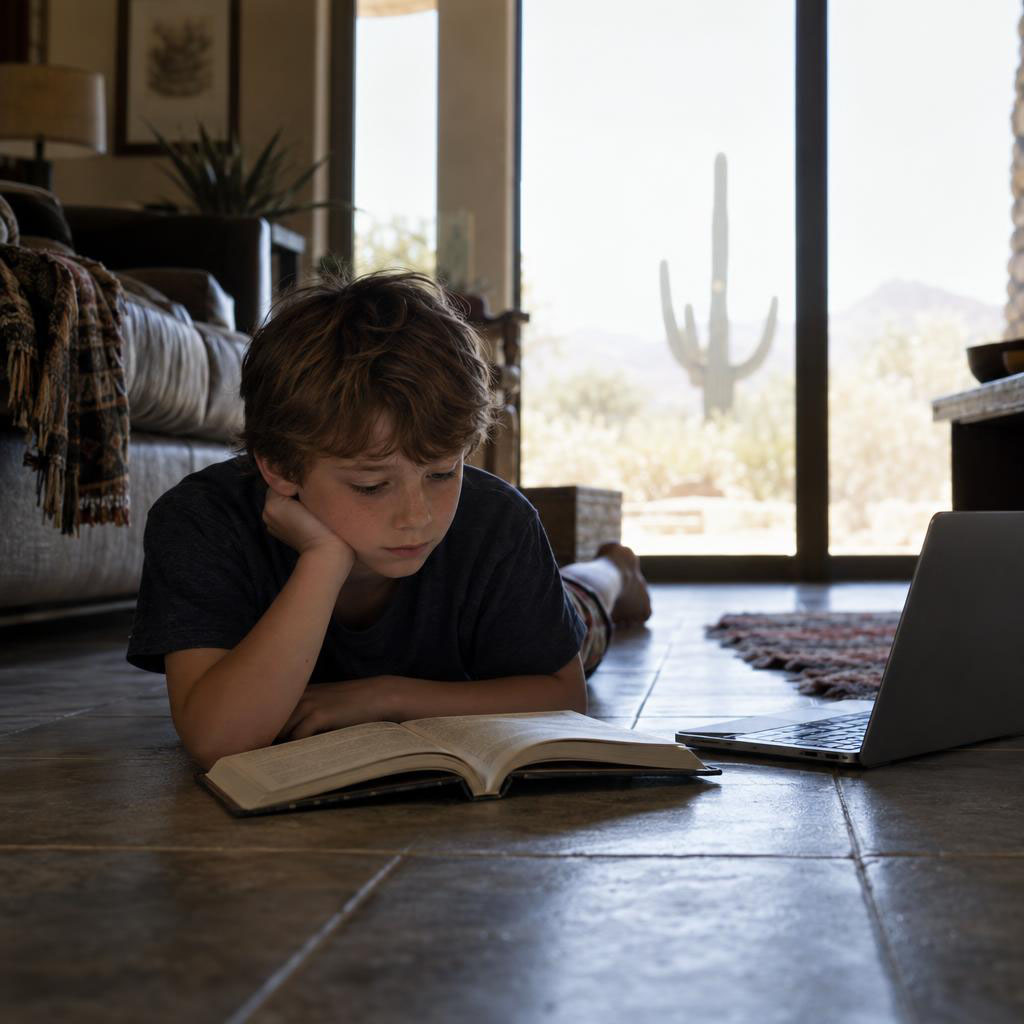
Online elementary school in Arizona: accredited options, how the universal ESA helps pay tuition, and what to look for when choosing a program for K-5.

An online elementary school curriculum covers reading, math, science, and social studies across grades K-5. Here's what students learn and how it's taught.
Learn what live online classes look like for K-12 students, how formats compare, why class size matters, and where to find a truly personalized option. Explore now.